Anxiety Treatment West Orange, NJ
Anxiety Treatment West Orange, NJ: West Orange has more than 200 therapists. That sounds like an embarrassment of riches until you try to pick one, discover half are not taking patients, a third are out of network, and nobody can tell you which ones actually do the thing that treats anxiety.
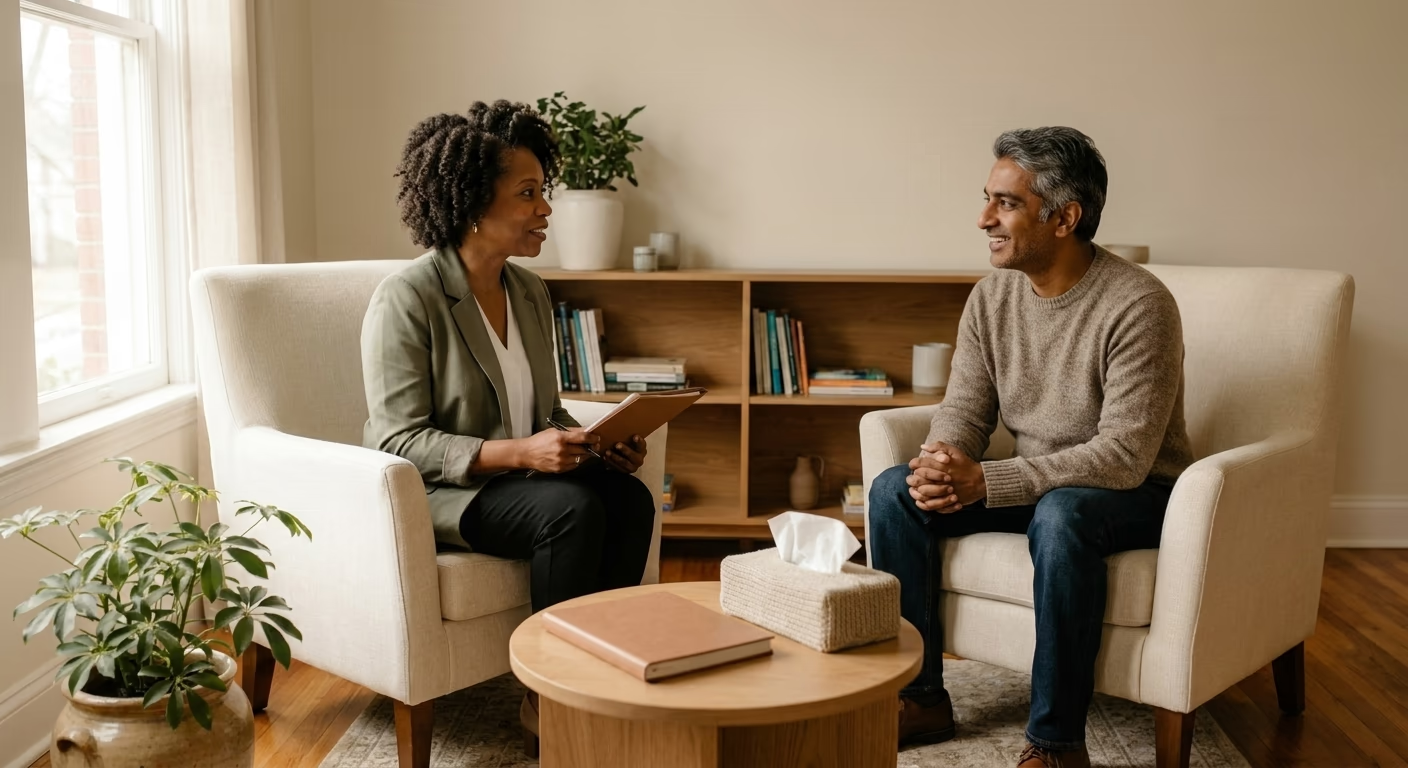
This page is a guide to anxiety treatment West Orange NJ residents can actually get: what works, who provides it, what it costs, and how to filter 200 names down to three calls. Written by a psychiatric practice that provides the medication half and refers for the rest.
(908) 201-3904 · Book a free 15-min call→ · Maplewood, ten minutes from West Orange, or by telehealth across New Jersey
Psychiatric evaluation and medication management, age 12 and up
In person or by video · Medicaid, NJ FamilyCare, Medicare and 18 insurance plans accepted
We do not provide therapy of any kind — we refer, and we coordinate
If you are in crisis right now
Call or text 988 any time. For immediate danger, call 911.
West Orange is in Essex County. The county's psychiatric emergency screening service is at Clara Maass Medical Center, Belleville — (973) 844-4357, around the clock, and it assesses anyone regardless of insurance or ability to pay.
Other lines: NJ Mental Health Cares 866-202-HELP · NAMI-NJ 866-626-4664 · Peer Recovery Warmline 877-292-5588 · PerformCare 1-877-652-7624 for anyone under 21.
The condition
What anxiety disorders actually are
Anxiety disorders are the most common mental health challenges there are — roughly one in five adults in New Jersey and nationally meets criteria for an anxiety disorder in a given year. Anxiety disorders are also the most treatable conditions in psychiatry, and the most likely to go untreated for a decade first. They respond at every age.
Everyone feels anxious. The anxiety disorders differ in three ways: the anxiety is out of proportion, it does not switch off when the situation resolves, and it costs you something.
Generalized anxiety disorder
Worry more days than not for six months, across multiple areas, with muscle tension, restlessness, poor concentration, irritability and broken sleep. Generalized anxiety is the one people describe as a background hum they cannot turn off.
Panic disorder
Sudden surges of fear peaking within about ten minutes, with chest tightness, racing heart, dizziness and a conviction that something catastrophic is happening. Panic disorder is the pattern: recurring panic attacks plus at least a month of dreading the next one.
Social anxiety disorder
Intense fear of being judged. Routinely mistaken for shyness, routinely the most disabling of the group, and routinely untreated because people assume it is a personality trait rather than something that has narrowed a whole life.
Specific phobias
Heights, needles, driving, flying, vomiting. Narrow, intense, and among the most treatable conditions in all of psychiatry with the right protocol — a phobia that has shaped someone's life for twenty years can resolve in eight sessions.
Related conditions
Obsessive compulsive disorder sits in its own diagnostic category now, but obsessive compulsive disorder is still what many people mean when they describe unbearable anxiety with rituals attached. PTSD likewise. Both need specific protocols, and treating them as generic anxiety fails.
What it costs
Avoidance is the engine. The list of things you do not do grows quietly — the highway, the meeting, the phone call, the party — and by the time people seek treatment, the anxiety is smaller than the life that shrank around it. Daily life narrows one decision at a time and nobody notices until the map is small.
Anxiety damages relationships as much as it damages the person: partners get recruited into reassurance, families reorganize around what is tolerable, and everyone stops mentioning it. Restoring those relationships is part of the work rather than a by-product, and relationships recover faster than people expect once the avoidance stops.
What works
Therapy options that actually treat anxiety
There is a real hierarchy here, and it is worth knowing before you call anyone.
Cognitive behavioral therapy
The most evidenced therapy for every anxiety disorder there is. CBT targets the thoughts that convert an ordinary sensation into a catastrophe, and pairs that with exposure. Twelve to sixteen sessions, with homework between them where most of the change happens. If a therapist in West Orange lists one method, this is the one you want.
Exposure and response prevention
ERP is the specific protocol for obsessive compulsive disorder and for specific phobias — approaching the feared thing while deliberately not performing the ritual or the escape. It is uncomfortable by design and it works faster than almost anything else in mental health care.
Acceptance and commitment therapy
ACT suits people who have already tried and failed to push through, and who need a different relationship with the anxiety rather than a fight with it.
EMDR
Used to treat traumatic events and relational trauma rather than anxiety generally. Where the anxiety sits on top of trauma — which it often does — EMDR is the referral.
Mindfulness and relaxation techniques
Breathing work, progressive muscle relaxation and mindfulness practice genuinely reduce the physical and emotional symptoms of anxiety. They work best as a supplement to a protocol, not as the protocol.
Holistic and lifestyle integration
Caffeine down, alcohol down, aerobic exercise up, sleep protected. These change how well the treatment works rather than replacing it, and dismissing them is as unserious as relying on them alone.
Group therapy
Group therapy for social anxiety has a specific advantage a room with one person cannot reproduce: the feared situation is in the room. Group therapy for generalized anxiety is more variable, and worth asking about rather than assuming.
Medication
The part we do
Medication management for anxiety usually means evaluating whether an SSRI or SNRI is indicated. Sertraline, escitalopram, paroxetine, venlafaxine and duloxetine are all first line.
What to expect on the timeline
Started lower in anxiety than in depression, because early jitteriness is the reason most people quit a medication that would have worked. Some effect by week two, meaningful change at four to six weeks, full benefit at eight to twelve.
The others
Buspirone for generalized anxiety. Hydroxyzine short-term. Propranolol for situational physical symptoms — the hands, the voice, the racing heart before a presentation.
Benzodiazepines
A narrow role: a short bridge in the first weeks of an SSRI, or a handful of predictable situations. Daily long-term use is not the standard of care, and they blunt the exposure work the therapy depends on. We will explain the reasoning rather than simply refusing.
Medication plus therapy
For moderate to severe anxiety the combination beats either arm alone, and that combination is the standard of care rather than a preference. That is the single most useful sentence on this page, and it is why this practice refers rather than pretending to do both.
Choosing
What kind of doctor is best to see for anxiety?
Depends what you need, and the honest answer is that most people need two clinicians rather than one.
For medication
A psychiatrist (an MD with a psychiatry residency) or a psychiatric nurse practitioner. Both diagnose and prescribe. In New Jersey, psychiatric nurse practitioners prescribe under a joint protocol with a collaborating physician. Your primary care doctor can also start an SSRI and often does it well, particularly if they have known you for years.
For therapy
A licensed therapist trained in CBT. The license matters less than the training.
Reading the credentials
LCSW — a licensed clinical social worker holds a master's in clinical social work plus supervised hours, and the licensed clinical designation is what allows independent practice. Clinical social workers are the largest group of licensed professionals doing therapy in New Jersey, and clinical social work training makes them strong when benefits, housing, school or immigration are tangled into the clinical problem.
LPC — licensed professional counselor, master's level. A counselor with this license is independently licensed and the most common credential you will see. Licensed professional counselors, licensed clinical social workers and licensed psychologists are all licensed mental health professionals and all licensed professionals in New Jersey; the letters describe the training route rather than the quality.
LMFT — a family therapist trained in couples and family systems.
PhD or PsyD — licensed psychologists, who hold doctoral degrees in psychology or clinical psychology, provide therapy and formal testing, and do not prescribe in NJ.
The two questions that matter
Do you use CBT with exposure for anxiety, and are you taking new patients this month? Any licensed therapist will answer both immediately, and mental health professionals who hesitate on the first are telling you something. Vagueness there is your answer.
Other mental health professionals — psychiatrists, nurse practitioners, primary care — can handle the medication side while the therapist handles the method. Two clinicians who talk to each other beat one who does everything.
What type of therapy is best for anxiety?
Cognitive behavioral therapy with exposure, for almost everyone. ERP specifically for OCD and phobias. ACT where CBT has already failed or where the exposure structure is intolerable. Anyone who cannot name a method is describing supportive conversation, which is pleasant and is not treatment.
Cost
What anxiety treatment costs in West Orange NJ
The average therapy session in West Orange runs about $180, which is at the upper end of the usual US range of $100 to $200. West Orange is an expensive town and the rates reflect it.
With insurance
Clients pay a copay, commonly $20 to $50 for behavioral health. Whether a clinician is in network is the single biggest determinant of what you actually spend, so ask before the first session rather than after it.
Sliding scale
Many West Orange therapists hold a few sliding-scale slots and almost none advertise them. Ask directly. Community mental health services and counseling services across Essex County offer sliding scale that reaches zero at low incomes, and federally qualified health centers see people regardless of ability to pay. These services exist in and around West Orange NJ and are chronically under-used.
Is there any free online group therapy for anxiety?
Yes, with one caveat: what is free is peer support rather than clinical group therapy led by a licensed therapist.
NAMI New Jersey runs free support groups across NJ, including online ones
The Anxiety and Depression Association of America lists free online peer groups
Mental Health America hosts free peer communities
Recovery International and Emotions Anonymous run free structured peer meetings, and some churches and community centers in West Orange host counseling-adjacent support groups
None of these replaces counseling or treatment. All are available this week, which treatment usually is not, and that makes them worth the hour.
Families
Anxiety in families, and what families can do
Anxiety runs in families in both senses. It is substantially heritable, so families frequently contain several anxious people who have never compared notes. And it reshapes the household around itself, which is where families get stuck.
Accommodation is the trap
Well-meaning family members accommodate: they make the phone call, they drive the route, they provide the reassurance, they let the avoided thing stay avoided. Every accommodation lowers the anxiety today and raises it tomorrow. Families are not doing anything wrong — they are doing the loving thing, and the loving thing happens to feed the disorder.
What families can do instead
Stop providing reassurance on demand, gently and with warning rather than abruptly
Support the exposure rather than the escape — go with them to the thing rather than making the excuse for them
Say what you have noticed, specifically, without a diagnosis attached
Improve communication by naming the pattern out loud rather than tiptoeing around it
Get your own support; families of anxious people carry more stress than anyone acknowledges, and it wears on relationships over time
Anxiety in children and adolescents
Anxiety disorders in children show up as stomach aches, refusal, anger and clinginess far more than as stated worry. School refusal in adolescents is almost always anxiety wearing a different coat. Families who treat it early do enormously better, children respond to CBT faster than adults do, and family relationships recover quickly once the pattern breaks.
We treat adolescents from age 12. For children under 12, PerformCare at 1-877-652-7624 is New Jersey's entry point and serves children and families across NJ around the clock.
Family therapy and couples work
Family therapy has real evidence where the household has organized itself around one person's anxiety, and family therapy for adolescents with caregiver involvement is standard. A family therapist trained in this does something individual therapy cannot: change the system rather than the person inside it. We refer for it.
Free support for families in West Orange NJ
NAMI New Jersey's Family-to-Family course is free, evidence based, and built for exactly this. Families across Essex County use it and very few have heard of it.
Recovery
What healing from anxiety actually looks like
Healing is a word this field overuses, so here is what healing means in practice. Not a mood, and not a moment — a set of things that come back into your life one at a time.
Healing is measurable
The healing that matters is a count, not a feeling: places you go again, calls you make, nights you sleep through, things that come off the avoided list. We track those, because they move before the mood does, and because healing you can point at is easier to keep faith with than healing you have to feel.
Healing happens in a rough order
Sleep first. Then the physical symptoms settle. Then the avoidance list starts shrinking, which is the part that takes deliberate work and the most important step in the whole sequence. Emotional confidence returns last and lags the symptoms by weeks — people read that lag as failure when it is the ordinary shape of the recovery journey, and the emotional aspects of healing are simply slower than the physical ones.
Healing is not linear
Bad weeks happen, especially under stress, and stress at work or at home is the usual trigger. A bad week after three good months is not a relapse, and the healing holds underneath it. Knowing that in advance is worth more than any reassurance afterwards.
The journey has an end
Unlike much of psychiatry, anxiety treatment has a finish line for a lot of people: a completed course of therapy, a medication taper, and a set of skills that stay. The journey is not lifelong for most, and saying so is not false optimism — it is what the outcome data shows. Plenty of people overcome an anxiety disorder completely and get their life back, and to overcome it fully is the expected outcome rather than the exception.
Where compassion fits
Self-compassion is not a soft extra here. People with anxiety are ferociously hard on themselves, and that harshness is itself a maintaining factor. Compassion toward the anxious version of yourself is part of the mechanism rather than a wellness slogan, and wellness culture has done anxiety no favors by treating it as a mindset problem.
Telehealth
Online therapy and telehealth services
Online therapy is as effective as in person therapy for anxiety in most studies, and it removes the barrier that actually stops people: the trip. Telehealth services are available across New Jersey from clinicians licensed in New Jersey — that is the rule that matters, and you must be physically in NJ during the session.
Where in person therapy still wins
Severe illness with safety concerns, a first evaluation where the physical picture matters, anything requiring an exam or labs, and anyone whose home is not private. In person therapy also suits people for whom leaving the house is itself the exposure.
What we do by video
Psychiatric evaluation and medication management, anywhere in New Jersey, with in person available in Maplewood whenever something needs a closer look.
Local
Getting here from West Orange
The practice is at 1585 Springfield Avenue, Maplewood, NJ 07040 — about ten minutes from most of West Orange NJ, with free parking directly outside. It is easily accessible from Pleasant Valley Way, Northfield Avenue and Prospect Avenue in West Orange NJ, and considerably easier to park at than anywhere in the Essex County town centers. For anyone in West Orange NJ without a car, NJ Transit runs buses toward Maplewood and South Orange — check njtransit.com for current routes and times.
Most patients use telehealth. Both are available, and mixing them is normal. Clients in West Orange NJ who begin by video often switch to in person later, or the reverse when life gets busy.
Which is safer, East Orange or West Orange, NJ?
People ask this, so: West Orange has substantially lower reported crime rates than East Orange. Both are Essex County townships, both have long-established communities, and both have residents who need and deserve care — this practice serves patients in both.
The clinically relevant part is smaller than the question implies. Chronic exposure to an unsafe environment does produce genuine anxiety symptoms, and where that is someone's reality, treatment does not require pretending otherwise. And anxiety is no less common in comfortable suburbs; it simply presents differently, and gets hidden better.
The practice
How this works
What we do: psychiatric evaluation, diagnosis, medication management, psychoeducation inside the visit, coordination with your therapist, and ongoing care from one clinician. Those are the services in full; clients get the same clinician every visit.
What we do not: individual therapy, family therapy, couples work, group therapy, addiction or substance abuse counseling, crisis services, or children under 12.
Who you would see
Teresa Omwenga is a Board-Certified Psychiatric Mental Health Nurse Practitioner treating adolescents from 12, adults and older adults across New Jersey. She is not a psychiatrist, and you should know which you are seeing.
What the first visit covers
We begin with current symptoms, psychiatric history, medical history, medications, substances, sleep, stress at work and at home, and what your week actually looks like. About an hour. It produces a diagnosis and a plan, in person or by video.
How the room works, and how clients find it
A safe space here means something specific and non judgmental: you can say you stopped the medication, or that you have been drinking more, without bracing for a lecture. An edited history produces a worse plan, so the practice is built to make the honest version easy. Being a good listener is table stakes rather than a differentiator — what matters is what happens with what you say.
What we coordinate
We talk to your therapist and to your GP. Where the anxiety sits alongside depression, bipolar disorder, ADHD or trauma, the plan changes, which is why the evaluation screens for all of them. Depression travels with anxiety about half the time, and a plan that treats only one of the two underperforms.
The first step
Anxiety responds to treatment better than almost anything else in psychiatry. What stands between most people and that is not the treatment — it is the first step, the phone call, which anxiety is specifically designed to make difficult.
The free 15-minute call covers fit, cost, insurance and services, with no diagnosis and no prescribing attached. Most clients find it settles the question in ten minutes. If what you need is a CBT therapist rather than a prescriber, we will say so and help you find one.
Maplewood Mental Health Clinic · 1585 Springfield Avenue, Maplewood, NJ 07040 · (908) 201-3904 · serving West Orange NJ and Essex County · Book a free 15-min call→ · In crisis: 988
Take the next step.
Start with a free 15-minute call. We will talk through fit, timing, and insurance — there's no obligation to book an evaluation after the call.