Panic Attack Treatment West Orange, NJ
Panic Attack Treatment West Orange, NJ: Panic attack treatment West Orange NJ residents can get is unusually effective, which is worth saying first because panic is the most frightening thing on this website and one of the most treatable. Panic-focused CBT resolves it for most people in three to four months, and most of them get the parts of life they had given up back with it.
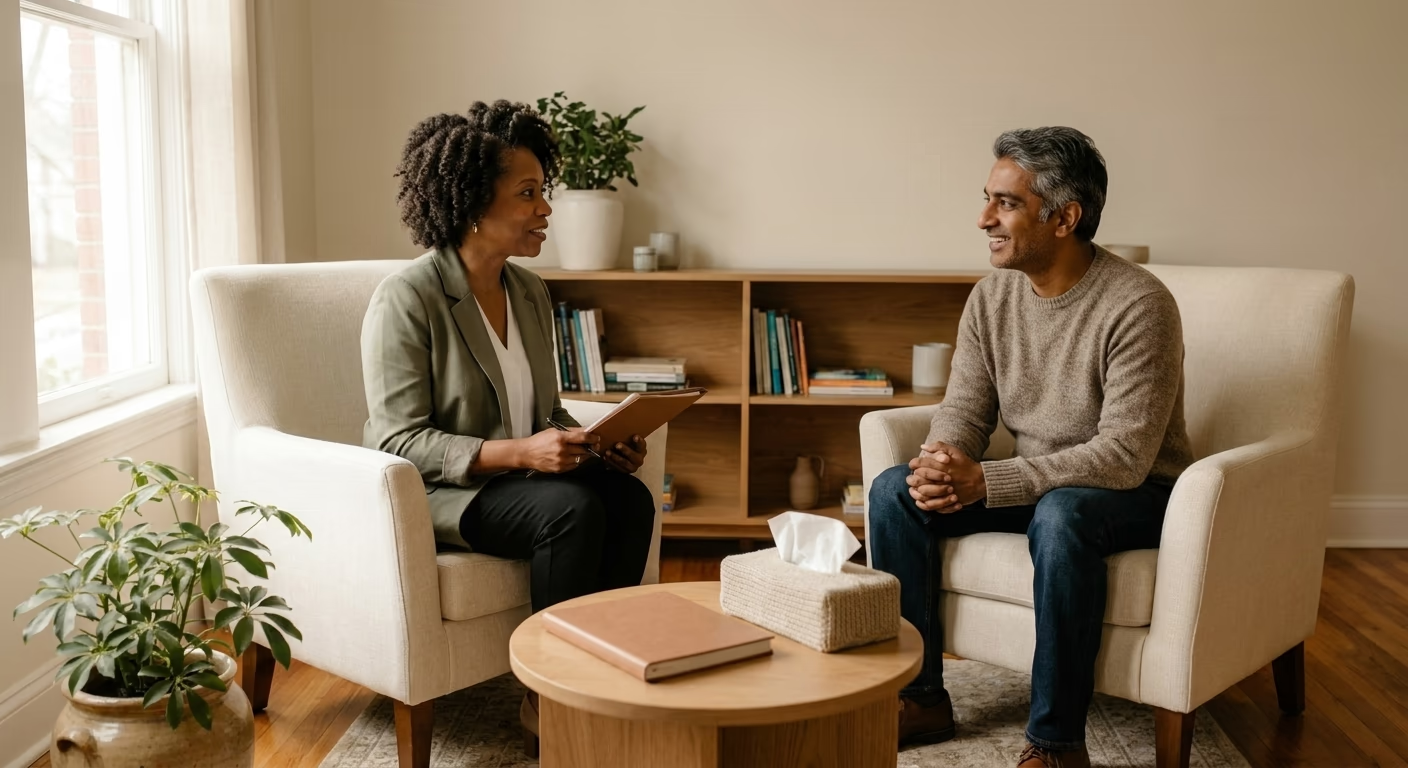
This page covers what a panic attack is, how to get out of one, which therapy actually works, what kind of doctor to see, and what it costs in West Orange NJ.
(908) 201-3904 · Book a free 15-min call→ · Maplewood, ten minutes from West Orange, or by telehealth across New Jersey
Psychiatric evaluation and medication management, age 12 and up
In person or by video · Medicaid, NJ FamilyCare, Medicare and 18 insurance plans accepted
We do the medication half. No therapy here — we refer and coordinate
If you are in crisis right now
Call or text 988 any time. For immediate danger, call 911.
West Orange NJ is in Essex County. Psychiatric emergency screening is at Clara Maass Medical Center, Belleville — (973) 844-4357, around the clock, regardless of insurance or ability to pay.
Also: NJ Mental Health Cares 866-202-HELP · NAMI-NJ 866-626-4664 · Peer Recovery Warmline 877-292-5588 · PerformCare 1-877-652-7624 for anyone under 21.
The condition
What a panic attack actually is
A panic attack is a surge of intense fear that peaks within about ten minutes and brings a full set of physical symptoms with it. Nothing is wrong with your heart. Everything is wrong with your alarm system, which has fired at full strength with nothing to fire at.
What happens in the body
Racing heart, chest tightness, shortness of breath, dizziness, sweating, shaking, numbness or tingling, nausea, chills or flushing, and the two that frighten people most — derealization, where the world goes flat and unreal, and the conviction that you are dying or losing your mind.
This is the body's threat response running at full power. Every symptom on that list is a normal part of it. The only thing that has gone wrong is the timing.
Panic attack or anxiety attack
They are not the same thing and the difference matters for treatment. Anxiety builds over minutes or hours, has an object, and stays at a moderate level for a long time. A panic attack arrives in seconds, often with no trigger at all, peaks hard and fast, and is over in ten to thirty minutes. Anxiety is a slow leak. Panic is an explosion.
Most people with panic disorder also carry background anxiety. Both respond to the same family of treatment, but the panic part needs its own specific work.
What is panic disorder?
One panic attack is not a disorder — an enormous number of adults have one at some point and never have another. Panic disorder is recurrent unexpected attacks plus a month or more of dreading the next one, or of changing your life to avoid it.
That second half is the disorder. The attacks are unpleasant; the fear of the attacks is what shrinks a life, and the emotional cost of a life spent arranging around exits is usually larger than the attacks themselves. When the avoidance spreads to public places, driving, or being far from home, it is called agoraphobia, and it develops in a substantial share of untreated cases.
Why it feels like dying
Because the sensations are real. The heart really is racing; the chest really is tight. The brain reads those signals, concludes something catastrophic is happening, and releases more adrenaline — which produces more sensations, which confirm the conclusion. That loop is the entire mechanism of panic disorder, and it is exactly what treatment takes apart.
Right now
How to get out of a panic attack
The sensations feel overwhelming, and the feeling is not lying about their intensity — only about their meaning. The honest answer first: you do not need to get out of it. A panic attack ends on its own, every time, usually inside twenty minutes, because your body cannot sustain that level of adrenaline. Nobody has ever had a panic attack that did not stop.
What actually helps in the moment
Slow the out-breath. Not deep breaths — long ones out. In for four, out for six or eight. The long exhale is what engages the parasympathetic brake, and it is the only breathing instruction with a physiological reason behind it.
Name what is happening. "This is a panic attack. It peaks and it passes. It has never once not passed." Directly addressing negative thought patterns is essential in CBT for panic disorder, and this is that skill in its smallest form.
Stay where you are if you can. Leaving works, which is the problem — it teaches the brain that leaving is what saved you, and the next attack arrives with the same instruction.
Let the sensations run. Fighting them adds adrenaline. Mindfulness techniques can help regulate the nervous system during panic attacks precisely because they ask you to observe the sensations rather than wrestle them.
Feet on the floor, something cool to hold. Physical anchors help some people and do nothing for others. Use them if they help; drop them if they turn into a ritual you feel you have to perform.
What makes it worse. Fighting it. Rapid shallow breathing or breathing into a bag. Checking your pulse. Searching symptoms on your phone. Calling someone to be told you are fine. Leaving the situation every single time. All of these give a few minutes of relief and strengthen the loop.
After it passes. Eat something, drink water, expect emotional flatness and to feel wrung out for a few hours — that is the adrenaline clearing, not a sign of damage. Write down where you were and what you noticed first. That record is the raw material your therapist will use.
What is the 3-3-3 rule for panic attacks?
Name three things you can see, three sounds you can hear, and move three parts of your body. It is a grounding exercise, it is widely shared, and it is genuinely useful for a lot of people.
Two honest caveats. It has no formal evidence base of its own — it is a simplified piece of grounding practice, not a studied protocol. And in panic disorder specifically, anything you do to make an attack stop can quietly become a safety behavior: the brain concludes it survived because of the ritual, and the underlying fear never updates. Use grounding to get through the day. Use therapy to make the attacks stop coming.
When to seek urgent medical care: first attack ever, chest pain that radiates, fainting, symptoms that last well beyond thirty minutes, or anything that feels different from your usual pattern. Urgent medical care is important for potentially serious symptoms that may resemble panic attacks, and no competent clinician will think less of you for going.
Treatment
What type of therapy is best for panic attacks?
Psychotherapy is considered a first-line treatment for panic attacks, and among the therapy options one stands clearly above the rest.
Cognitive behavioral therapy
Cognitive Behavioral Therapy is considered the gold standard for panic disorder, and CBT is effective for anxiety treatment generally. Panic-focused CBT typically includes gradual exposure to feared situations alongside cognitive work on the catastrophic interpretations. Expect roughly twelve sessions; treatment for anxiety can take 5-20 weekly sessions to show results depending on how long the avoidance has been building.
Three components do the work. Psychoeducation — understanding the adrenaline loop removes a surprising amount of the fear on its own. Cognitive restructuring — testing "I am having a heart attack" against the evidence, repeatedly, until the thought loses authority. Exposure — which is the part that actually resolves it.
Interoceptive exposure
This is the technique most people have never heard of and the one that does the heavy lifting. Rather than exposing you to places, it exposes you to the sensations: spinning in a chair for dizziness, breathing through a straw for breathlessness, running up stairs for a racing heart.
You deliberately produce the feelings you fear, in a safe room, until your brain stops reading them as an emergency. It sounds unpleasant and it is, briefly. It is also why panic has one of the best outcome profiles of all the anxiety disorders.
Exposure and response prevention
Exposure and Response Prevention (ERP) is a specialized subset of CBT used for panic treatment as well as for obsessive compulsive disorder. In panic it targets the safety behaviors — the water bottle, the seat near the exit, the friend on speed dial — by having you face the situation without them.
Exposure therapy is a common method for treating anxiety disorders as a whole, and in panic it is not optional. Talk therapy without exposure tends to produce insight and no change.
Other approaches with a role
Dialectical Behavior Therapy teaches emotional regulation and distress tolerance, and dialectical behavior therapy skills help most where panic sits on top of long-standing emotional instability. Acceptance and commitment therapy works on the relationship to the sensations rather than their frequency. Group therapy normalizes panic faster than individual therapy can, and clients learn as much from the room as from the clinician. Individual therapy remains the default format, and family therapy or couples therapy helps where the household has reorganized around one person's avoidance.
Holistic alternatives such as acupuncture may be included in treatments for panic attacks, and the honest framing is this: they are reasonable additions if they help you feel better, and they are not substitutes for exposure-based treatment. Nothing that only reduces arousal will teach your brain that the sensations are safe.
How long it takes
Panic-focused CBT: roughly eight to fifteen sessions. Therapy may require 5-20 sessions to show results, and panic sits at the faster end of that range. Medication: antidepressant medications typically take two to four weeks to work and eight to twelve for full effect. Most people notice the attacks losing their teeth before they notice them stopping.
What kind of doctor should I see for panic attacks?
The short answer: your primary care doctor first, then a psychiatrist or psychiatric nurse practitioner for medication, and a CBT therapist for the treatment that resolves it.
Start with a physical
A short medical workup rules out the conditions that mimic panic: thyroid disease, arrhythmia, anemia, low blood sugar, asthma, and — commonly missed — the effect of caffeine, decongestants, stimulants and alcohol withdrawal. Your medical history and a basic set of bloods settle most of it in one visit.
This is not a formality. An accurate diagnosis is the point of the exercise, and a small number of people sent for panic treatment have something else entirely.
Then the psychiatric route
Psychiatrists are physicians who diagnose and prescribe. Psychiatric nurse practitioners also diagnose and prescribe; in New Jersey they work under a joint protocol with a collaborating physician. Psychologists provide therapy and testing and do not prescribe here. Therapists — LCSW, LPC, LMFT — provide therapy.
For panic specifically, the therapist matters more than the prescriber. Ask any therapist you call whether they do interoceptive exposure. If the answer is vague, keep calling.
What comprehensive care looks like. Comprehensive care for panic means a prescriber and a therapist who talk to each other, a written treatment plan with an endpoint, and someone paying attention to whether the avoidance is shrinking rather than only whether the attacks are. A personalized plan is not a marketing phrase here; it means the exposure ladder is built from your feared situations, not a template.
Medication for panic
Medication management is crucial for effective treatment of mental health disorders, and in panic it plays a specific supporting role. Medication is best used to improve a patient's headspace for therapy — it lowers the volume enough that exposure work becomes possible.
SSRIs and SNRIs
Medication management can include selective serotonin reuptake inhibitors (SSRIs) and short-term anti-anxiety medications. Sertraline, escitalopram, fluoxetine and paroxetine all carry evidence in panic disorder; venlafaxine does too.
One rule specific to panic: start low and go slow. SSRIs can transiently increase anxiety in the first week, and in a panic patient that feels like proof the medication is dangerous. Starting at half the usual dose avoids most of this, and any prescriber who treats panic regularly already knows it.
Medication management helps maximize treatment benefits and minimize side effects, which in practice means someone is checking in at weeks two, four and eight rather than handing you three months of refills. Psychopharmacologists collaborate with patients on medication use decisions — you should know what each agent is for, what it may do, and what the exit plan is.
The benzodiazepine question
Anti-anxiety medications typically take 20-30 minutes to work, which is exactly why they are so appealing in panic and exactly why they cause trouble. They stop an attack. They also teach the brain that the attack needed stopping, which undermines the exposure work that would have resolved it.
There is a narrow legitimate use: a short bridge while an SSRI takes effect, or a small supply for genuinely exceptional situations. Long-term daily use in panic disorder is a poor bargain, and tolerance and dependence are real.
What medication cannot do. It does not teach your brain that a racing heart is safe. Only exposure does that. Severe distress from panic attacks may require a combination of therapy and medication, and the combination beats either alone — but if you take only one, take the therapy.
The anxiety disorders that sit next to panic
Roughly 40 million adults in the U.S. experience anxiety disorders, and panic rarely travels alone. Sorting out which anxiety disorders are present changes the plan.
Generalized anxiety disorder. Generalized anxiety is chronic worry across many domains rather than discrete attacks. Generalized anxiety disorder and panic frequently coexist, and CBT for one is not automatically CBT for the other.
Social anxiety disorder. Social anxiety, sometimes called social phobia, is fear of judgment rather than fear of sensations. Where panic attacks occur only in social settings, social anxiety disorder is usually the primary diagnosis and the exposure work looks different.
Obsessive compulsive disorder. Obsessive compulsive disorder shares the ERP treatment pathway with panic but targets obsessions and compulsions instead of bodily sensations.
Depression. Depression follows panic often, usually driven by the shrinking life rather than by the attacks. Cognitive behavioral therapy is effective for treating depression as well, therapists use evidence-based practices to treat depression, and transcranial magnetic stimulation is a treatment option for depression where several medications have failed. We refer for TMS; we do not provide it.
Substance abuse. Alcohol is the most common self-treatment for panic and the most reliable way to make it worse, because rebound anxiety in the hours after drinking is itself a panic trigger.
Health anxiety. Where every sensation gets interpreted as disease, health anxiety and panic feed each other, and the physical health reassurance-seeking is the behavior to target.
Bipolar disorder and eating disorders both need ruling out before an antidepressant is started, for different reasons and with equal seriousness.
Every one of these anxiety disorders responds to treatment. The reason for listing them is that the right treatment differs, and a plan built for the wrong one wastes a year of your life.
Families
For families
Panic is a family condition whether or not anyone says so, and families end up carrying part of it. Families see more panic attacks than clinicians do, and families are usually given no instructions at all. What follows is the short version, because families who understand the mechanism stop making it worse by accident, and families who do not will keep helping in the ways that entrench it.
What helps during an attack
Stay calm and stay nearby. Say plainly: "This is panic. It will pass. I am here." Do not leave unless they ask. Do not offer solutions. Speak slowly and keep your own breathing long and low, because a family member's steadiness is contagious in both directions.
What does not help
"Calm down." "There's nothing to be scared of." Rushing them to the ER for the fifth identical attack. Rearranging every family plan around the avoidance, which feels like love and functions as reinforcement.
The hardest part for families. The most loving thing a family can do is the least intuitive one: stop accommodating. Driving them everywhere, ordering for them, always going along to be the safe person — each of these shrinks the world a little further. Accommodation reduction is a real part of treatment, and the therapist should be coaching families through it rather than leaving them to guess.
Teens and young adults
In teens, panic frequently shows up as school refusal or as repeated trips to the nurse with stomach complaints, and families are usually the first to notice the pattern. Young adults are the group most likely to self-medicate and least likely to tell anyone. Panic responds very well to CBT at both ages, and early treatment prevents the years of avoidance that make it stubborn. We treat adolescents from age 12; for children under 12, PerformCare at 1-877-652-7624 is New Jersey's entry point.
Relationships
Relationship challenges around panic follow a pattern: one person becomes the designated safe person, resents it, feels guilty for resenting it, and says nothing. Naming that out loud helps. Couples therapy helps more where it has been going on for years, and treating the panic properly helps most of all. Relationships recover faster than most people expect once the avoidance stops dictating the calendar.
One more thing for families. Panic disorder is hard on families in a way that rarely gets acknowledged: the low-level alertness, the cancelled plans, the sense that daily life now runs on somebody else's nervous system. Families supporting someone through this get worn down, and families who look after their own mental health do better at looking after anyone else's. NAMI's free family programs exist for exactly this, and families across Essex County use them.
Local
Panic treatment across West Orange NJ
West Orange NJ has a large supply of mental health care and a small supply of clinicians who do interoceptive exposure. That gap is the practical problem for anyone in West Orange looking for panic treatment.
Where to look
Psychology Today lets you filter therapists in West Orange NJ by anxiety specialty, insurance and telehealth. The Anxiety and Depression Association of America publishes a clinician directory filtered for CBT. Your insurance company's directory is the most reliable in network filter and is frequently out of date, so call to confirm. Your primary care doctor is the most underrated referral route in West Orange NJ.
A note on the words. Practices advertise under a dozen labels — mental health issues, behavioral health issues, psychiatric care, mental health concerns — and the label rarely tells you what is inside. The method does. Ask any experienced team which treatment options they actually deliver for panic, and how they support clients through the exposure part, and the answer separates them quickly. Navigating anxiety care in a town this well supplied is mostly a filtering problem, and four questions on the phone does most of the filtering.
What to ask on the phone
Do you use CBT for panic. Do you do interoceptive exposure. How many sessions do you expect. Do you take my insurance. Four questions, three minutes, and they will separate a highly trained panic clinician from a generalist faster than any profile will.
Where the rest of the system fits. Structured outpatient programs can provide support for severe panic attacks and anxiety where weekly therapy is not enough — several run within reach of West Orange NJ. Community mental health centers in Essex County take Medicaid and sliding-scale clients and see patients nobody else will fit in. NAMI groups cost nothing, run across the county, and take families as well as patients. Mental health care in West Orange NJ is not scarce; it is unsorted, and the sorting is the work.
Practical
Cost, insurance and telehealth
Insurance
Mental health treatment is an essential health benefit under the ACA, and federal parity law requires insurance coverage no more restrictive than for physical health conditions. What parity does not settle is who is in network, what your copay is, and whether prior authorization is needed.
We accept Medicaid, NJ FamilyCare, Medicare and 18 commercial plans, and we verify your specific plan on the free call. Since January 2025 New Jersey has run NJ FamilyCare behavioral health through managed care, so the card in your wallet now decides your network.
Self-pay
Therapy in this part of New Jersey commonly runs $150 to $200 a session, and West Orange sits near the top of that band. Sliding scale exists at many private practices and at every community clinic in Essex County, and it is almost never advertised. Ask.
Telehealth
Telehealth services are available across New Jersey, and telehealth therapy is effective for major depression and anxiety. Telehealth services include individual, couples, and family therapy at most practices that offer it, and psychiatric evaluations and medication management run over video without losing much.
Two panic-specific notes. Video is an advantage where leaving the house has become part of the problem — treatment can start before the avoidance is addressed. And it is a limitation for exposure work that needs to happen in the feared setting, which is a good reason to plan for some in person sessions later in the course.
On licensing: a clinician must be licensed in the state where you are sitting during the appointment. Practices licensed in multiple states can follow you when you travel; most solo New Jersey practices, including this one, cannot. Ask before you book a session from a hotel.
The practice
How this practice works
What we do: psychiatric evaluation, accurate diagnosis, medication management, psychoeducation, coordination with your therapist and your GP, and continuing care from one clinician. Helping patients get the therapy half arranged is part of the job rather than an afterthought, and helping patients keep the therapy and the medication in step with each other is most of the rest of it.
What we do not: therapy of any kind, CBT, exposure work, group therapy, family therapy, substance abuse treatment, crisis services, TMS, or children under 12.
The first appointment
About an hour: current symptoms, when the attacks started, what you have stopped doing because of them, medical history, medications, caffeine and alcohol, sleep. It produces a working diagnosis and a written treatment plan. In person in Maplewood or by video.
Continuity
The person who evaluates you is the person adjusting the dose two years from now. In panic that matters because the taper — and there usually is one — goes better with someone who remembers what the first month was like.
A supportive environment, concretely
A supportive environment here means you can say the medication made week one worse, or that you have been drinking to sleep, without bracing for a lecture. We provide compassionate care in the only sense that means anything: an edited history produces a worse plan, so the room is built to make the honest version easy to say. That holds regardless of who you are, your background, or your gender identity.
Getting here
1585 Springfield Avenue, Maplewood, NJ 07040 — about ten minutes from most of West Orange, free parking directly outside, easy from Pleasant Valley Way, Northfield Avenue and Prospect Avenue. Call (908) 201-3904, Mon–Fri 9am–5pm, or book the free call online. There is no intake form to complete first.
Recovery
What recovery from panic looks like
Panic has the best outcome profile of the anxiety disorders, and the shape of recovery is predictable enough to describe in advance.
The attacks get smaller before they get rarer. A five-minute wobble instead of a twenty-minute emergency is progress, even though the count has not changed.
The fear of the fear goes first. Once you stop dreading the next one, the loop has already broken, and the frequency usually follows within weeks.
Your world gets bigger again. The highway, the supermarket, the train, the meeting — the parts of a life that get handed back one at a time. Recovery in panic is measured in where your life goes, not in how you feel; daily functioning is the honest scoreboard.
One attack is not a relapse. Panic can return under stress, after illness, in the middle of the life transitions that unsettle everyone — a move, a birth, a bereavement, a job that changed shape. Life transitions are the usual setting for a second round, and having the skills already means it does not take hold. People who have been through treatment describe the second time as an inconvenience rather than a catastrophe.
Two things patients report a year out that belong on this page. The first is that the relationships which survived the avoidance often come out stronger, because something had to be said out loud that had gone unsaid for years. The second is that adults who have been through panic treatment describe a kind of personal growth they never asked for: having proved the catastrophic thought wrong several hundred times, other catastrophic thoughts carry less weight afterward. That is meaningful change, and it generalizes well past the panic.
Recovery also has aspects no prescription reaches. Sleep, caffeine, alcohol, exercise and stress load all move the baseline, and the coping strategies you build in therapy are yours permanently. Some people describe the whole thing as a healing journey and a piece of self discovery; others describe it as a nuisance they fixed in four months. Both are accurate, and neither is required.
What emotional well being looks like on the far side of panic is unremarkable: you notice your heart beating after stairs and think nothing of it. Overall well being returns quietly, the way it does after any illness, and most people only notice it retrospectively — usually when they catch themselves making a plan without checking whether it is escapable. Well being of that kind is the real endpoint, and relationships tend to recover on the same schedule. Self esteem takes a beating during panic disorder — feeling afraid of your own body is humiliating in a way people rarely admit — and it comes back too, usually last.
The first step
Panic lies in a very particular way: it tells you that this time is the real emergency. It has said that every time so far and it has been wrong every time so far.
The free 15-minute call covers fit, cost and insurance — no diagnosis, no prescribing, no pressure. If what you need is a CBT therapist rather than a prescriber, we will say so and point you at one, because for panic that is frequently the honest answer.
Making the call is the first step, and the first step is the only part of panic treatment that nobody can do for you. Everything after it is somebody's job.
Maplewood Mental Health Clinic · 1585 Springfield Avenue, Maplewood, NJ 07040 · (908) 201-3904 · serving West Orange NJ and Essex County · Book a free 15-min call→ · In crisis: 988
Take the next step.
Start with a free 15-minute call. We will talk through fit, timing, and insurance — there's no obligation to book an evaluation after the call.