Depression Treatment West Orange, NJ
Depression Treatment West Orange, NJ: Depression treatment West Orange NJ residents can actually get starts with one decision: whether you need a psychiatrist, a therapist, or both. Most people need both, most people start with neither, and the gap between those two facts is where years get lost.
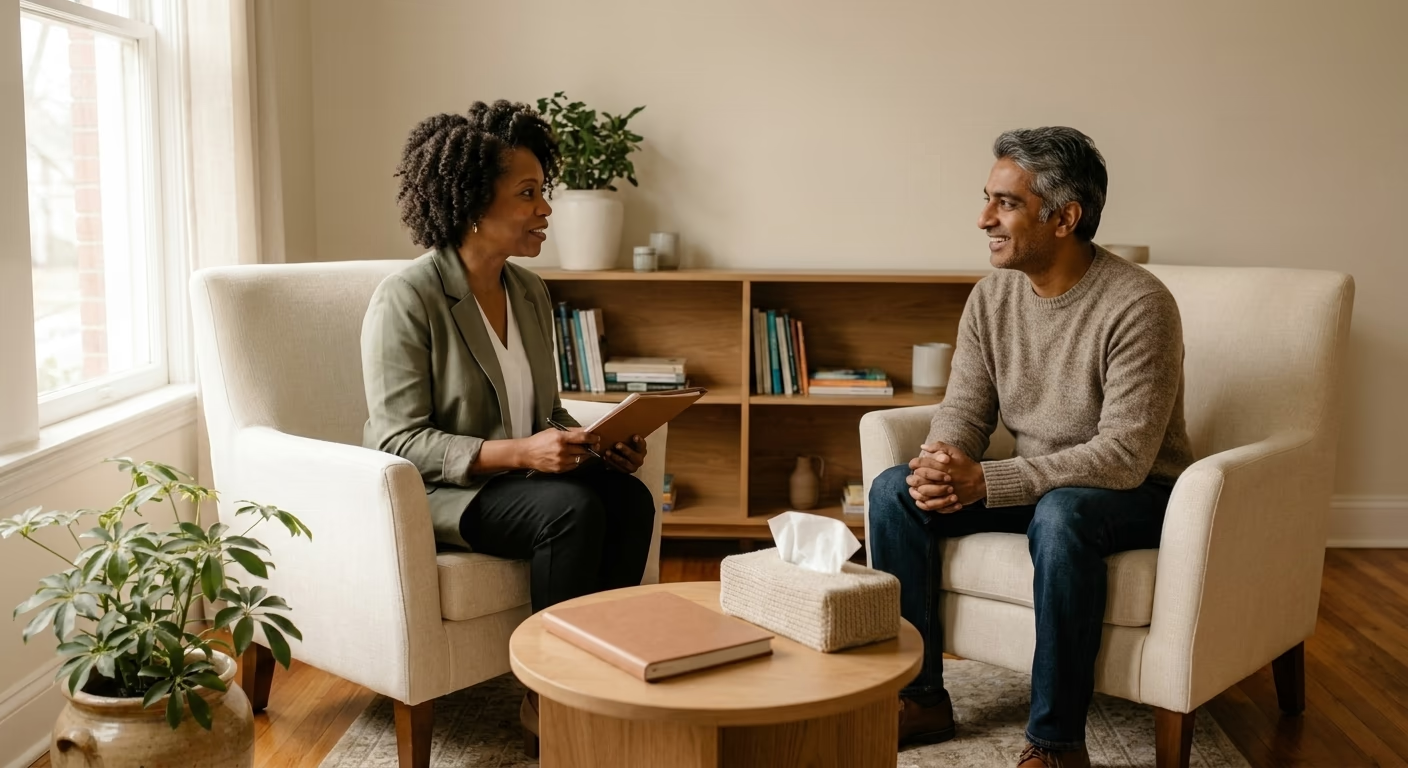
This page covers what works for depression, how to find a psychiatrist in West Orange NJ, what it costs, and what to do when nothing has helped so far.
(908) 201-3904 · Book a free 15-min call→ · Maplewood, ten minutes from West Orange, or by telehealth across New Jersey
Psychiatric evaluation and medication management, age 12 and up
In person or by video · Medicaid, NJ FamilyCare, Medicare and 18 insurance plans accepted
We provide the medication half only — no therapy here, but we refer and coordinate
If you are in crisis right now
Call or text 988 any time — the Suicide and Crisis Lifeline is staffed 24/7 by trained people, and you do not have to be suicidal to use it. For immediate danger, call 911.
West Orange NJ is in Essex County. Psychiatric emergency screening is at Clara Maass Medical Center, Belleville — (973) 844-4357, around the clock, regardless of insurance or ability to pay.
Also: NJ Mental Health Cares 866-202-HELP · NAMI-NJ 866-626-4664 · Peer Recovery Warmline 877-292-5588 · PerformCare 1-877-652-7624 for anyone under 21.
The condition
What depression actually is
Depression is a medical condition, not a mood and not a character flaw. It is diagnosed on a cluster of symptoms persisting two weeks or more and costing you function.
The core symptoms
Low mood or lost interest — one of the two has to be present. Then: broken sleep or too much of it, appetite and weight change, concentration that fails, energy that does not return with rest, disproportionate guilt, and in many cases thoughts of death or suicide. Anxiety rides along with depression in more than half of cases, and untreated anxiety is one of the more common reasons a depression that should have responded does not.
What it costs
Depression takes the ordinary machinery of a life apart: the unopened mail, the missed shifts, the friendships that thinned out, the relationships strained by something nobody named. Emotional flatness is more common than visible sadness, which is why families often describe someone as "not themselves" rather than as depressed.
What are the six types of depression?
People ask this, so here is the honest version: there is no official list of six. What the diagnostic manual actually describes is a set of depressive disorders, and the six most commonly referred to are these.
Major depressive disorder. Episodes of two weeks or more, often recurring.
Persistent depressive disorder (dysthymia). Chronic low-grade depression lasting at least two years. Lower intensity, higher total cost, and frequently missed for decades because the person has no non-depressed baseline to compare against.
Bipolar depression. The depressive pole of bipolar disorder. This distinction matters more than any other on this page: an antidepressant given alone in unrecognized bipolar disorder can trigger mania. Any competent evaluation asks about past elevated periods even when you came in about the lows.
Seasonal affective disorder. Depression following the light, which in New Jersey means roughly November to March.
Peripartum depression. During pregnancy or in the year after birth, and it affects fathers and non-birthing partners too.
Premenstrual dysphoric disorder. Severe mood symptoms in the luteal phase, distinct from ordinary PMS and genuinely treatable.
Other mental health conditions sit close by and get confused with these — anxiety disorders, PTSD, grief, and the mood disorders of thyroid disease. Sorting them out is what the evaluation is for.
Finding care
How to find a psychiatrist in West Orange NJ
West Orange has a real supply of psychiatric care, which is not true of every town in New Jersey. The problem is not supply, it is matching.
What a psychiatrist does
A psychiatrist is a physician — medical school plus a four-year psychiatry residency — who diagnoses mental health conditions, prescribes and manages medication, and treats the complex cases. Some psychiatrists also provide therapy; most in private practice now do not, and a psychiatrist who does only medication management is the norm rather than a shortcoming.
Psychiatrist, PMHNP, psychologist, therapist
Psychiatrists prescribe and manage medication. Psychiatric nurse practitioners (PMHNPs) also diagnose and prescribe; in New Jersey they practice under a joint protocol with a collaborating physician. Licensed psychologists provide therapy and formal testing and do not prescribe in NJ. Therapists — LCSW, LPC, LMFT — provide therapy and do not prescribe.
Most people doing well long-term have a prescriber and a therapist who talk to each other. A psychiatrist alone treats half the problem; a therapist alone treats the other half.
What to look for in a psychiatrist in West Orange
Credentials and experience with your specific condition. A psychiatrist who sees depression weekly is a better bet than one who sees it occasionally, whatever else is on the CV.
Whether they coordinate. Integrated practices coordinate care between therapists and psychiatrists, and that coordination measurably improves outcomes. A psychiatrist who will not talk to your therapist is handing you a job you should not have.
In network status. Verify insurance before the first appointment rather than after it. This is the single most common avoidable expense in West Orange NJ mental health care.
Availability. Ask for the next available appointment on the first contact. Some West Orange psychiatrists have months-long waits; some do not.
Telehealth. Most psychiatrists in West Orange NJ now offer telehealth appointments for psychiatric evaluations and medication management, which removes the travel problem entirely.
Where to look
Psychology Today and Zocdoc both let you filter psychiatrists in West Orange NJ by insurance and specialty. Your insurer's directory is the most reliable in-network filter, though frequently out of date — call to confirm. Your primary care doctor's referral is the most underrated route, because they already know your history.
A note on this page. We are a psychiatric practice, not a psychiatrist's office: Teresa Omwenga is a Board-Certified Psychiatric Mental Health Nurse Practitioner, not a psychiatrist. For most outpatient depression the scope is the same. You should know the difference and decide for yourself, and if what you want is specifically a psychiatrist, the directories above will find you one in West Orange.
Treatment
What actually treats depression
Evidence-based treatment for depression is medication, psychotherapy, or both — and for moderate to severe depression, both beats either alone.
Psychotherapy
Cognitive behavioral therapy has the strongest evidence. CBT effectively treats depression symptoms by targeting the thought patterns depression generates and presents as fact, paired with behavioral activation. Expect 16 to 20 sessions for a full course.
Interpersonal therapy targets role transitions, grief and disputes, and does well where an identifiable life event set the episode off.
Behavioral activation on its own has good evidence and is the most portable technique in the field: schedule the activity before the motivation arrives, because in depression motivation follows action rather than preceding it.
Mindfulness-based cognitive therapy has its strongest evidence for preventing relapse after recovery rather than for treating an acute episode.
Group therapy and family therapy both have a place. Group therapy ends the isolation that depression builds; family therapy helps where the household has reorganized around one person's illness. Outpatient psychotherapy in West Orange NJ includes individual, group and family therapy, and most practices offer all three. All of these methods treat anxiety as well, which matters because the two conditions arrive together far more often than either arrives alone. Therapy can help no matter which pattern, stressor, or related issue brought you in.
Medication
First-line: sertraline, escitalopram, fluoxetine, citalopram, paroxetine, plus venlafaxine and duloxetine among the SNRIs. No first-line agent clearly beats the others for the average patient, so the choice comes down to side-effect profile, other conditions, and what has worked for blood relatives.
Bupropion where fatigue and low motivation dominate. Mirtazapine where sleep and appetite are the worst of it.
The timeline. Some movement by week two, meaningful change at four to six weeks, full benefit at eight to twelve. Most people who quit early quit in week two or three, when the side effects have arrived and the benefit has not.
Medication management for depression is crucial and it is not the prescription — it is the ongoing monitoring of what changed, what did not, and what side effects arrived. That is the part this practice does.
Levels of care
Weekly outpatient — a prescriber plus a therapist — is where most depression treatment happens and where it should start. Outpatient programs at higher intensity sit above it: an intensive outpatient program runs about three hours a day, three days a week, and several operate in Essex County. Partial hospitalization is more again. Inpatient is for safety.
Practical questions
What should I do if I feel too depressed to get out of bed?
This is the most practical question on the page and it deserves a real answer rather than encouragement.
Right now, today
Lower the bar until it is crossable. Sit up. Put your feet on the floor. Open a window. Drink water. That is a complete, sufficient morning when depression is this heavy, and treating it as a failure is the depression talking.
Eat something, even badly. Open the curtains — light exposure in the first hour genuinely affects mood. Do not lie there scrolling, which feels like rest and functions as rumination.
This week
Tell one person. A partner, a friend, a sibling, a loved one — anyone. Depression's first move is isolation and the counter-move is telling someone out loud.
Make one call: your primary care doctor, a psychiatrist, or 988 if it is heavier than that. Ask that person to sit with you while you make it if calls have become impossible, which they often do.
When it is more than that
If you cannot eat, cannot get up for days, or are having thoughts of ending your life, this is an emergency and not a willpower problem. Call 988, or go to the Clara Maass screening center, or ask someone to take you. People do recover from exactly this point, routinely.
What should I do if nothing is helping my depression?
Before concluding that nothing works, check whether anything has actually been tried properly. Most "treatment-resistant" depression turns out to be under-treated depression.
Five things to check first
Was the medication trial adequate? Six to eight weeks at a therapeutic dose. Four weeks at a starter dose is not a trial, and a great many people have had four of those and been told they are resistant.
Was the therapy the right kind, for long enough? Sixteen to twenty sessions of a depression-specific method. Four sessions of general supportive conversation is not a failed course of therapy.
Is the diagnosis right? Unrecognized bipolar disorder, untreated trauma, ADHD, thyroid disease, sleep apnea, anemia and heavy drinking all look like treatment-resistant depression and none responds to more of the same.
Is something maintaining it? Alcohol or another addiction, an unsafe home, chronic pain, untreated trauma, a job that is genuinely intolerable. Medication does not out-treat an ongoing cause.
Are both arms in place? A surprising number of people have had medication alone or therapy alone and never the combination.
If all five check out
Genuine treatment-resistant depression has real options, and this is where a psychiatrist becomes necessary rather than optional.
Augmentation — lithium, a second-generation antipsychotic, thyroid hormone, or a second agent from another class. Esketamine (Spravato), available at certified centers in New Jersey. TMS, non-invasive and covered by many insurance plans after failed medication trials, with several providers in the West Orange area. ECT, which has the highest response rate of any depression treatment and a reputation forty years out of date.
None of these is available here. All are appropriate referrals, and we will make them rather than continue adjusting a plan that is not working.
What are the treatment options for severe depression?
Severe depression needs more than weekly visits. In rough order of intensity: an intensive outpatient program, partial hospitalization, inpatient admission where safety is the issue, and the interventional treatments above where several medication trials have failed. Severe depression is also the situation where a solo outpatient practice should say so, which we do.
Local
Depression care across West Orange NJ
West Orange offers outpatient psychiatric care services at a density most New Jersey towns do not have, which is both the advantage and the problem. There is no shortage of professionals here. There is a shortage of clear routes to the right one. Services across West Orange NJ address anxiety, depression, trauma and ADHD, usually under one roof, and the psychiatrists in West Orange provide medication management and in some practices therapy services alongside it.
Which services are for which problem
Private psychiatric practices. Evaluation, diagnosis and medication, typically four to eight weeks out. This practice is one of them, ten minutes east in Maplewood, and we see patients from West Orange NJ every week.
Private therapy practices. Weekly talk therapy. Most West Orange NJ therapists list themselves on Psychology Today, and most keep a short waitlist rather than none. Therapists in West Orange NJ vary widely on which plans they take, so settle network before you settle fit.
Community mental health centers. Essex County's community clinics take Medicaid and sliding-scale clients, run therapy and psychiatry under one roof, and are the right call when cost is the binding constraint rather than preference. For a good many clients they are also the only option that answers the phone the same week.
Hospital outpatient services. Several Essex County hospitals run outpatient behavioral health services for adults who need more structure than one hour a week.
Intensive outpatient services. Three to five days a week, several hours a day, for people too unwell for weekly care and not unwell enough for a bed.
Peer and family services. NAMI affiliates in Essex County and Mental Health Association groups cost nothing, and clients who use them alongside clinical care often describe them as the part that made the difference. Mental health organizations offer counseling and treatment support locally as well as peer groups, and a phone call to one of them is the fastest way to find out what actually exists near you.
What nobody tells you about West Orange NJ is that these services do not talk to each other unless somebody makes them. Ask each of the clinicians you see who else is on your team and whether they will write to them. Coordination between clinicians is the single most under-used free upgrade in mental health care.
Two other things worth knowing about care in West Orange NJ. First, "accepting new patients" on a directory is often eighteen months stale — call. Second, the professionals who answer their own phone are not less busy, they are usually solo, and solo practices are where continuity actually lives.
Psychiatric services in West Orange NJ are delivered by a mix of psychiatrists, psychiatric nurse practitioners and other mental health professionals, and the clinicians in each of those groups can prescribe. What differs is the training route and the caseload, not the legal authority. For adults in West Orange NJ the practical question is not which letters follow the name — it is whether that person will still be your clinician in three years.
A word on labels. People looking for help describe what they have in very different words — mental health issues, mental health challenges, a rough patch, burnout, stress — and the words rarely change what actually helps. What does change it is what is underneath. If your mental health issues include panic, intrusive worry or avoidance alongside the low mood, say so at the first appointment, because anxiety changes which medication makes sense and which therapy options are worth your money.
Families
For families and the people who love someone with depression
Families carry more of this than anyone acknowledges, and almost nobody explains the job.
What helps
Practical help beats advice. Meals, laundry, a ride to the appointment, sitting in the room without requiring conversation. Families who do the logistics do more good than families who do the pep talks.
Ask the direct question
Asking a loved one whether they have thought about ending their life does not plant the idea. It is frequently a relief, and it is the single most useful thing a family member can do.
What does not help
Telling them to exercise, or that others have it worse, or that they should snap out of it. None of it lands, and all of it teaches the person to stop mentioning it.
Look after yourselves
Families supporting someone with depression get depressed at elevated rates themselves. NAMI New Jersey's Family-to-Family course is free, evidence based and built for exactly this, and families across West Orange NJ use it. The loved one in the middle of it rarely has the spare energy to organize any of this, which is why families end up doing it. Mental health organizations including NAMI and Mental Health America offer peer support and advocacy locally at no cost.
Teens and adolescents
Depression in teens presents as irritability and withdrawal more than sadness, and school performance is often the first thing to slip. Teens in West Orange NJ frequently reach a school counselor first, and families are usually the ones who have to push it further than that. Evidence-based therapies work well for teen depression, and family involvement is part of the protocol rather than an add-on. We treat adolescents from age 12; for children under 12, PerformCare at 1-877-652-7624 is New Jersey's entry point.
Practical
Cost, insurance and telehealth
Insurance
Mental health treatment is an essential health benefit under the ACA, and federal parity law requires coverage no more restrictive than for physical conditions. What that does not settle is who is in network, what your copay is, and whether authorization is needed — insurance verification before the first appointment settles all three.
We accept Medicaid, NJ FamilyCare, Medicare and 18 commercial plans, and we verify your specific plan on the free call. Since January 2025, New Jersey moved NJ FamilyCare behavioral health into managed care, so the plan on your card now determines your network.
Self-pay and sliding scale
Therapy in this part of New Jersey commonly runs $150 to $200 a session. Sliding scale exists at many private practices and at every community clinic in Essex County, and it is rarely advertised. Ask — including at the West Orange practices whose websites say nothing about it. Psychiatrist fees run higher than therapist fees — $250 to $400 for a first evaluation with a private psychiatrist is ordinary in West Orange NJ, and a good deal less wherever insurance applies.
Telehealth
Telehealth appointments are available across New Jersey for psychiatric evaluations and medication management, and online therapy effectively treats major depression and anxiety disorders with outcomes comparable to a room. For depression specifically, removing a trip you have to talk yourself into is a clinical advantage rather than a convenience.
Telehealth also solves a specifically local problem: the drive from West Orange NJ to almost anywhere in Essex County is ten minutes at noon and forty at five o'clock, and a missed appointment because of traffic is still a missed appointment.
In person still wins for a first evaluation where the physical picture matters, anything needing labs, acute safety concerns, and anyone whose home is not private.
The practice
How this practice works
What we do: psychiatric evaluation, diagnosis, medication management, psychoeducation, coordination with your therapist and your GP, and ongoing care from one clinician. Those are the psychiatric services in full.
What we do not: therapy of any kind, group therapy, family therapy, addiction treatment, crisis services, TMS, esketamine, or children under 12.
The first appointment
About an hour: current symptoms, psychiatric history, medical history, medications, substances, sleep, and what your week actually looks like. It produces a working diagnosis and a written plan. In person in Maplewood or by video.
Continuity
The person who evaluates you is the person who adjusts the dose in two years. That continuity is worth more in depression than almost any other feature of a practice, because the clinician who remembers what failed in 2023 makes better decisions in 2027. Patients who stay with one clinician through the whole arc of healing need fewer medication restarts than patients who change hands every year.
A supportive environment, concretely
A welcoming environment and a supportive environment mean something specific here: you can say you stopped the medication, or that you have been drinking more, without bracing for a lecture. An edited history produces a worse plan. We understand that the honest version is harder to say, and the practice is built to make it easy.
Getting here
1585 Springfield Avenue, Maplewood, NJ 07040 — about ten minutes from most of West Orange, with free parking directly outside. Easily reached from Pleasant Valley Way, Northfield Avenue and Prospect Avenue, and a straightforward run from anywhere in West Orange NJ. Contact us on (908) 201-3904, Mon–Fri 9am–5pm, or book the free call online — there is no intake form to complete first. Contact by phone is fastest; we serve West Orange and the Essex County towns around it.
Recovery
What healing from depression actually looks like
People arrive expecting healing to feel like a light switch. It almost never does, and understanding the real shape of it prevents the most common mistake in treating depression, which is stopping three weeks before the treatment works.
Function returns before mood does. You get up, eat, answer the messages and do the work while still feeling flat. That gap is normal and it is not failure — it is the first half of healing arriving on schedule. Healing leads with function and catches up on feeling later, almost every time.
Sleep and appetite move first. These are the earliest measurable signs that a medicine is doing something, often by week two, well before anything feels different from the inside.
The bad days keep happening. Recovery is not the absence of bad days. It is bad days that last a day instead of a season.
Healing is not linear. A bad two weeks in month four does not undo month three. Most patients describe the journey as a climb with switchbacks rather than a straight line, and the switchbacks are the part nobody warns them about.
Relapse is a risk, not a verdict. Roughly half of people who have one episode have another, which is why the maintenance phase matters as much as the acute phase, and why the journey is measured in years rather than appointments.
Healing has aspects that no prescription reaches. Sleep, movement, daylight, alcohol, stress load, and whether you have anyone at all to talk to are not soft extras — they are structural, and they change how well the medicine works. Coping skills learned in therapy, the psychological work of changing what you believe about yourself when you are low, and the slow rebuilding of relationships that depression thinned out are the other half of the journey. This practice refers for that half rather than providing it.
Two practical notes that patients in West Orange NJ ask about. Exercise has a real antidepressant effect and it is not a substitute for treatment; the honest framing is that it raises the ceiling rather than replacing the floor. And the psychological half of it usually starts only once the worst of the physical weight lifts, which is why healing in that order is normal rather than backwards. Wellness, well being, whatever word you prefer for it: it arrives late, and it arrives quietly.
Mental wellness is not a marketing word here. Mental wellness means you get your life back — not that you stop having feelings, and not that the emotional weather is permanently fair. Wellness of that second kind does not exist in anyone, depressed or not.
What suffering less looks like, in the accounts patients give a year in: the mail gets opened, the phone stops being a threat, food tastes like something, and there is a range of feeling again instead of one gray setting. Well being is the term the research literature uses. Getting your Saturdays back is what people actually mean by it, and it is a reasonable thing to expect.
One last caution, from the far side of all this. Feeling well is the most common reason people stop medication, and stopping the month you finally feel well is how a great many second episodes begin. Bring it to the appointment instead. Stopping well is a plan with a taper, not a decision made on a good Tuesday.
The first step
Depression lies about the odds. It tells you this is permanent, that treatment will not work for you specifically, and that you are the exception. Most people who recover were also certain they would not.
The free 15-minute call covers fit, cost and insurance — no diagnosis, no prescribing, no pressure. If what you need is a psychiatrist, a therapist, or a program rather than this practice, we will say so and point you at it.
When you contact us, ask how soon the first appointment actually is — it is the question most people from West Orange forget to ask, and it is the one that decides whether treatment starts this month or next. Depression has already taken enough of the calendar.
Maplewood Mental Health Clinic · 1585 Springfield Avenue, Maplewood, NJ 07040 · (908) 201-3904 · serving West Orange NJ and Essex County · Book a free 15-min call→ · In crisis: 988Maplewood Mental Health Clinic · 1585 Springfield Avenue, Maplewood, NJ 07040 · (908) 201-3904 · serving West Orange NJ and Essex County · Book a free 15-min call→ · In crisis: 988
Comprehensive Mental Health Services in West Orange NJ
Our outpatient psychiatric care in West Orange NJ includes psychiatric evaluation, medication management, and supportive therapy led by Teresa Omwenga, PMHNP-BC, a Board-Certified Psychiatric Mental Health Nurse Practitioner. We provide care for adults, adolescents, and older adults with mood disorders, anxiety, trauma, OCD, ADHD, bipolar disorder, autism spectrum-related care, and geriatric mental health needs.
Psychotherapy Options
We offer evidence-based psychotherapy options including Cognitive Behavioral Therapy (CBT) and Interpersonal Therapy (IPT), which effectively treat depression symptoms by addressing negative thought patterns and social difficulties. Mindfulness-based cognitive therapy is also available, especially for relapse prevention after recovery. Our services include individual, group, and family therapy formats to support anxiety, depression, trauma, and ADHD.
Medication Management
Medication management is a crucial part of our depression treatment approach, ensuring ongoing monitoring and adjustment of prescribed medications like SSRIs, SNRIs, bupropion, and mirtazapine to optimize benefits and minimize side effects.
Telehealth Services
We provide telehealth appointments across New Jersey, allowing for convenient psychiatric evaluations, medication management, and therapy support. Telehealth is especially useful for those managing major depression and anxiety disorders, offering accessibility and flexibility without compromising care quality. Family Healing Center also offers telehealth appointments for mental health support.
Experienced and Licensed Clinicians
Our clinic is led by Teresa Omwenga, PMHNP-BC, with a dedicated team of licensed clinicians. In the broader West Orange area, psychiatrists such as Dr. Samuel Oliver Sostre, practicing since 2005, and Dr. Alena Antohina, practicing since 2011 with specialized training from Albany Medical Center, provide medication management and therapy services.
Integrated and Coordinated Care
We emphasize integrated practices that coordinate care between therapists and psychiatrists, improving treatment outcomes through collaboration.
Community Resources
West Orange residents have access to community resources like NAMI-NJ for peer support and advocacy, as well as emergency support available 24/7 through the 988 Suicide & Crisis Lifeline.
Our clinic accepts Medicaid, NJ FamilyCare, Medicare, and 18 insurance plans, with insurance verification provided before the first appointment. We also offer sliding scale payments to accommodate varying financial needs.
Contact us to schedule your free 15-minute consultation and begin your journey to mental wellness with trusted, comprehensive care tailored to your needs.
Take the next step.
Start with a free 15-minute call. We will talk through fit, timing, and insurance — there's no obligation to book an evaluation after the call.