Anxiety Treatment Livingston, NJ
Anxiety Treatment Livingston, NJ: Anxiety treatment Livingston NJ residents can get is effective, well understood, and usually shorter than people expect. Anxiety disorders are the most treatable conditions in psychiatry, and the main obstacle in Livingston NJ is not availability — it is knowing which of the many services on offer you actually need.
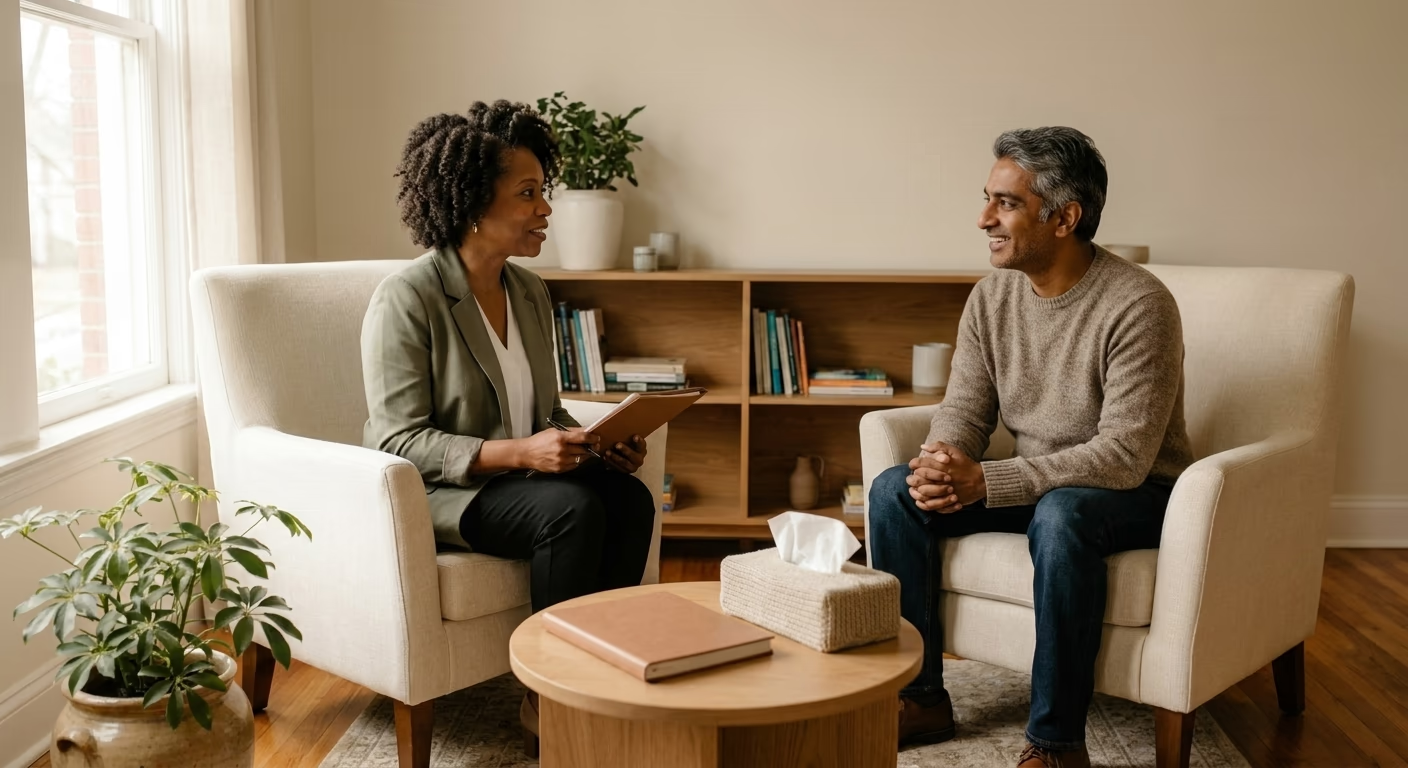
This page covers what the anxiety disorders are, which therapy has the evidence, what medication does, how the levels of care differ, and where to look in Livingston NJ specifically. It is written for adults and teens in Livingston and the towns around it.
(908) 201-3904 · Book a free 15-min call→ · Maplewood, about fifteen minutes from Livingston, or by telehealth across New Jersey
Psychiatric evaluation and medication management, age 12 and up
In person or by video · Medicaid, NJ FamilyCare, Medicare and 18 insurance plans accepted
We do the medication half. No therapy here — we refer, and we coordinate
If you are in crisis right now
Call or text 988 any time. For immediate danger, call 911.
Livingston NJ is in Essex County. Psychiatric emergency screening for Essex County is at Clara Maass Medical Center, Belleville — (973) 844-4357, around the clock, regardless of insurance or ability to pay. Cooperman Barnabas Medical Center is in Livingston itself and its emergency department is the nearest hospital for most residents.
Also: NJ Mental Health Cares 866-202-HELP · NAMI-NJ 866-626-4664 · Peer Recovery Warmline 877-292-5588 · PerformCare 1-877-652-7624 for anyone under 21.
The condition
What anxiety disorders actually are
Anxiety is a normal signal that has started firing without a signal to respond to. The anxiety disorders are what happens when that alarm runs long enough, or loud enough, to reorganize a life around avoiding it.
They are the most common mental health conditions in the country and among the most treatable. They are also the most commonly under-treated, because the symptoms are easy to explain away as personality, stress or simply being a worrier.
Generalized anxiety disorder
Excessive worry about several areas of life — work, health, money, family — most days for six months or more, with physical symptoms: restlessness, fatigue, an inability to focus, irritability, muscle tension, broken sleep. The loss of focus is frequently what finally brings someone in, because it is the symptom an employer notices. The worry moves from topic to topic and rarely settles.
Generalized anxiety disorder is the version people carry longest before asking for help, because nothing dramatic ever happens. It responds well to treatment.
Panic disorder
Sudden surges of intense fear that peak within ten minutes: racing heart, chest tightness, breathlessness, dizziness, a conviction of dying. Panic symptoms are so physical that most people meet a cardiologist before a psychiatrist.
Panic disorder is the attacks plus a month or more of dreading the next one, or of avoiding situations where one might happen. That avoidance is what shrinks the life, and it is what treatment targets.
Social anxiety disorder
Fear of judgment in social or performance situations, with avoidance that costs jobs, friendships and study. It usually starts in adolescence and it is routinely mistaken for shyness for a decade.
Phobias, health anxiety and separation anxiety round out the group, along with anxiety that arrives alongside other mental health issues — depression, ADHD, bipolar disorder, eating disorders and trauma all bring anxiety with them, and treating the anxiety alone in those cases does not work.
What anxiety is not. It is not weakness, and it is not a character trait you have to live around. It is also not the same as ordinary stress: stress has an object and eases when the object does, and an anxiety disorder does not.
Treatment
What are the treatment options for generalized anxiety disorder?
Three, and they combine well.
Psychotherapy and individual therapy
Psychotherapy is the first-line treatment for every anxiety disorder, and for mild to moderate generalized anxiety it is often enough on its own. Cognitive Behavioral Therapy is effective for anxiety treatment and is the method with the most evidence behind it; twelve to twenty therapy sessions is a typical course. Licensed therapists trained in CBT are not hard to find in Livingston NJ, and licensed therapists trained in the specific anxiety protocols are rarer. It is worth asking for the protocol by name when you call a Livingston NJ practice.
Medication management
Medication management often includes SSRIs or SNRIs for anxiety treatment, and medication management is a common treatment for anxiety disorders where the anxiety is severe enough to block the therapy. Sertraline, escitalopram, venlafaxine and duloxetine are the usual first choices. Expect four to six weeks for meaningful change.
Two cautions. SSRIs can transiently increase anxiety in the first week, so the starting dose should be low. And benzodiazepines work in twenty minutes, which is exactly why they are a poor long-term plan — they interfere with the learning that exposure work depends on.
The combination, and how long it takes. For moderate to severe anxiety disorders the combination outperforms either alone. A realistic timeline: some movement in three to four weeks, meaningful change by eight to twelve, and a decision about continuing medication at six to twelve months. Treatment plans that do not include an endpoint are not treatment plans.
What kind of therapy is best for anxiety?
Cognitive behavioral therapy
CBT is the answer for most people. It works on the thoughts that keep the alarm firing and on the behaviors that keep it credible, and it teaches skills you keep afterward. Ask any therapist directly whether they deliver CBT for anxiety and roughly how many sessions they expect — the answer separates a specialist from a generalist in one question.
Exposure therapy
Exposure therapy helps with fears and phobias related to anxiety and is the active ingredient in most anxiety treatment. You approach what you have been avoiding, in graded steps, without the safety behaviors, until the alarm stops firing. In panic it takes the form of interoceptive exposure — deliberately producing the sensations rather than the situations.
Talk therapy without exposure produces insight and very little change. That is the single most useful thing on this page.
Other approaches, and what to avoid. Acceptance and commitment therapy works on the relationship to the anxiety rather than its frequency. Mindfulness has real evidence as a support: practicing mindfulness or meditation can help reduce anxiety symptoms, and it works best alongside treatment rather than instead of it. Individual therapy is the standard format; group work normalizes anxiety faster than anything else; couples counseling helps where the anxiety has reorganized a relationship. What to avoid: open-ended supportive conversation with no method and no endpoint, and anyone promising a cure.
Levels of care
Outpatient, intensive outpatient program, partial care, residential treatment
Livingston NJ has an unusual concentration of higher-level programs, particularly for teens and young adults, and families in Livingston frequently do not know what the levels mean or who decides. Getting the level right the first time saves months, and getting it wrong in either direction is the commonest avoidable mistake in anxiety treatment.
Weekly outpatient
A therapist, a prescriber, or both, once a week or every other week. This is where the great majority of anxiety treatment happens and where it should start. It fits around school and work, and it is what this practice contributes to.
Intensive outpatient program
An intensive outpatient program runs roughly three hours a day, three to five days a week, usually in the late afternoon so school continues. Intensive Outpatient Programs are available for severe anxiety where weekly sessions have not been enough, and several operate in and around Livingston NJ. Most of the Livingston programs take referrals directly from families as well as from clinicians.
Partial care
Partial care — also called partial hospitalization — is the next step up: five to six hours a day, five days a week, with school work built into the day. Partial care programs exist for adolescents and for adults, and they are the level most often skipped when families jump straight from weekly therapy to a hospital conversation.
Residential treatment
Residential treatment means living at the program. For anxiety alone it is rare; it is used where anxiety sits alongside an eating disorder, self-harm, or a refusal to leave the house that has lasted months. Residential treatment is a major decision and a second opinion before enrolling is reasonable rather than rude.
Comprehensive care in this field means somebody is watching whether the level is right, and stepping down as well as up.
Anxiety in teens and young adults
Anxiety in teens looks like irritability, stomach aches, school refusal and a phone that never leaves the hand. Teens rarely use the word anxiety about themselves. School avoidance is the single most important sign to act on early, because every week away makes returning harder.
Young adults hit the same wall at the point the structure disappears — college, a first job, a move. Young adults are also the group most likely to stop treatment at a transition and the group where restarting is easiest.
For a family's everyday life, the useful things are: keep the routine, do not remove every demand, and do not do the avoiding for them. Accommodation feels like love and reinforces the disorder, and watching a loved one avoid something is far harder than watching them struggle through it — which is why the loved one doing the watching needs support of their own. A therapist should be coaching the family through that rather than leaving parents to guess.
Teens respond to CBT as well as adults do and often faster, because the avoidance has had less time to develop. What teens need from the adults around them is steadiness rather than reassurance: reassurance answers the anxious question and teaches it to come back. Families in Livingston NJ whose teens are struggling should expect the therapist to coach them on that directly, because it is one of the hardest challenges in the whole treatment and nobody manages it on instinct.
We treat adolescents from age 12; for children under 12, PerformCare at 1-877-652-7624 is New Jersey's entry point.
Can a person with anxiety live a normal life?
Yes — and not in a qualified way.
Anxiety disorders have among the best outcomes in psychiatry. Most people who complete a proper course of treatment reach a point where the anxiety is a thing that occasionally shows up rather than the thing that runs the week. Many stop medication afterward and keep the gains, because the skills stay.
What recovery looks like in practice: the physical symptoms settle first, the dread of the symptoms goes next, and the life comes back in pieces — the highway, the meeting, the party, the flight. Progress is measured in places you go rather than in how you feel. The journey has a shape people recognize afterward, and self confidence returns last, usually well after the anxiety has stopped being the main event.
What it takes honestly: doing the exposure work rather than talking about it, keeping the medication long enough to judge it, and not treating a bad two weeks as evidence of failure.
Mental wellness is the word most practices in Livingston NJ use for the destination, and it is worth defining. Mental wellness here does not mean never feeling anxious; it means the anxiety stops deciding things, and mental wellness in that sense is measurable in a way a mood is not. Well being of that ordinary kind — sleeping, working, seeing people, being able to focus on something for an hour — is the realistic target, and most people reach it inside a year. The journey is not linear and the journey is finite, which is a better combination than it sounds.
What patients report a year on: the skills stay, the physical symptoms are quieter, and managing symptoms takes minutes rather than the whole day. Daily life stops being organized around what might happen. The emotions have a range again. Self confidence returns slowly, and relationships improve — several people describe the change as learning to improve communication with the people who had been quietly managing them for years.
What resources can I find for anxiety?
More than most people know, and several cost nothing.
Free and low cost. NJ Mental Health Cares (866-202-HELP) is a free statewide referral line staffed by licensed professionals. NAMI New Jersey runs free support groups and family education across Essex County. The Anxiety and Depression Association of America publishes free self-help material and a clinician directory. Community mental health centers in Essex County take Medicaid and run sliding scales.
Directories. Online directories can help find local anxiety therapists in Livingston, NJ — Psychology Today and Zocdoc both filter by insurance, specialty and telehealth. Your insurance company's in-network list is the most reliable cost filter. Clinical guidelines for anxiety management can be reviewed through resources like the Mayo Clinic if you want to read the evidence yourself.
Self-help that actually works. CBT workbooks have real evidence when worked through properly. Apps help with practice and not with exposure. Peer groups end the isolation faster than anything clinical does, and hearing a stranger describe your own journey is worth a surprising amount.
When to seek help, and how soon. There is no threshold you have to cross first. The practical test is whether anxiety is affecting the things that matter — work, sleep, relationships, the ability to leave the house — and whether that has lasted more than a few weeks. Individuals who seek help early deal with less and recover faster, which is the whole importance of not waiting. If the wait for an appointment is long, ask to be put on a cancellation list and schedule something provisional in the meantime; a provisional date you can move is more helpful than an open question. Providers who offer structured approaches such as CBT, exposure work, and DBT skills groups run at different locations across Essex County, and finding one today is usually a matter of making four phone calls rather than four weeks of research. This practice will provide support with that even when the answer is not us.
Who else these resources serve. The same organizations help people other than the patient. Parents of an anxious teenager can find guidance and parent education without their child participating. Couples where one partner's anxiety has reshaped the household can be served as a couple. Seniors, whose anxiety is under-identified and often mistaken for a medical difficulty, are served by county aging offices alongside clinical care. And individuals who are not in acute distress but have had episodes before use these groups to stay well rather than waiting for the next difficult stretch. Relief does not have to begin with a prescription, and the process of getting better rarely starts in one place.
Local
Anxiety treatment across Livingston NJ
Livingston, New Jersey offers a range of professional mental health resources, and many mental health practices in Livingston specialize in treating anxiety disorders. The problem is sorting them, not finding them.
Where to look in Essex County
Psychology Today filters therapists and prescribers in Livingston NJ by anxiety, insurance and telehealth. Your insurer's directory is the reliable cost filter and is frequently out of date, so call. Your primary care doctor is an underrated referral route. Cooperman Barnabas Medical Center, in Livingston itself, runs behavioral health services and is the local route to higher levels of care for Livingston residents.
What to ask on the first call. Do you use CBT for anxiety, and do you do exposure. How many sessions do you expect. Do you take my insurance. How soon can I be seen. Four questions, three minutes, and they will tell you more than any amount of reading.
Mood disorders, bipolar disorder and eating disorders alongside anxiety
Anxiety rarely arrives alone, and a Livingston NJ practice should be looking for the rest of it. Depression is the most common companion, and depression treated alongside the anxiety does better than depression treated after it. Mood disorders including bipolar disorder change which medication is safe, and mood disorders that have never been diagnosed are the commonest reason an antidepressant makes anxiety worse. Eating disorders and anxiety travel together closely enough that any assessment should ask, and eating disorders need their own specialist care rather than general anxiety treatment. ADHD, trauma and OCD all produce anxiety as a by-product, and those disorders need treating in their own right rather than as anxiety with a label attached. Anxiety disorders that have not responded to two proper courses of treatment usually turn out to be a different set of disorders underneath. A practice offering psychiatric services should be screening for all of them at the first appointment rather than treating the presenting complaint in isolation.
Where the appointments actually are. Psychotherapy appointments in Livingston NJ are easier to find than prescriber appointments, and counseling of the general supportive kind is easier to find than protocol-driven psychotherapy. Patients who ask specifically for CBT get it; patients who ask for "someone good" get whoever has a slot. That distinction is worth two extra phone calls.
A word on marketing language. Practices advertise a warm and welcoming environment, a supportive environment, comprehensive care and personalized mental health care that adapts to evolving needs. None of those phrases tells you whether exposure therapy is on offer. The method does, and the unique needs of your particular case are addressed by the right protocol rather than by the right adjectives. Unique needs are real — a Livingston NJ teenager with school refusal and a Livingston NJ adult with health anxiety need genuinely different plans — but the phrase on a website tells you nothing about whether a practice can deliver them.
The rest of the vocabulary decodes the same way, and every phrase has a question hiding inside it. A practice advertising expertise and years of experience — how many years, and with anxiety specifically. A dedicated team of licensed clinicians — how many clinicians, and will I meet the same one each time. A mission to provide compassionate, comprehensive mental health care — what does this practice not treat. Evidence based care — which protocol, by name. Multiple locations and flexible hours — does that office actually have an opening this month. Providers who serve the whole family — do they serve adults and children with the same depth, or one properly and one as an afterthought. Ask those six questions and the marketing collapses into facts, which is all you wanted from it.
Two more places to look before you commit. The FAQs on a practice website usually reveal the real scope faster than the services page does, because that is where the exclusions end up. And the intake coordinator, if there is one, knows things the website does not: which clinicians have openings, which insurance claims actually get paid, and whether the evidence based protocol advertised on the homepage is something anyone there currently provides.
What evidence based should mean to you. The phrase gets used loosely, so here is the practical version: an evidence based treatment is one tested in trials against a control, with published results, delivered the way it was tested. For anxiety that means CBT, exposure therapy, and a short list of medications, rather than a vague set of supportive strategies. The importance of the distinction is that strategies with evidence behind them come with expected timelines, so you can tell within weeks whether the treatment is working. Individuals comparing options find it helpful to ask each practice which evidence based protocols it actually delivers, how many of its clinicians have experience with them, and how soon they could schedule a first visit. Contact two or three practices with those same three questions and the comparison becomes straightforward.
It is also worth understanding what treatment can and cannot offer. The goal is not to eliminate anxiety, which is a normal and useful signal, but to bring it back to a level where it stops making your decisions for you. The benefits people report are mostly ordinary: sleeping through the night, accepting an invitation, driving on the parkway again, feeling comfortable in a room full of strangers. Good mental health treatment provides tools you keep — the breathing exercises are the least of them, and the parts that last are problem solving skills, the ability to identify a spiral early, and a way to talk yourself down that you did not have before. Improved function arrives before improved mood in most people, and that order surprises them.
What a course of treatment looks like from the inside. The early sessions are mostly mapping: identifying the patterns, the triggers, and the feelings that arrive before the thought does. The middle is where the work happens — building strategies you practice between sessions, and deliberately doing the things you have been avoiding. The later sessions are about relapse prevention, which means recognizing the early signs and having a written path back. A realistic goal for generalized anxiety is meaningful improvement within twelve to sixteen sessions, and clients who do the between-session practice get there faster than clients who only attend. Control is the wrong frame, and it is the frame almost everyone arrives with: the goal is not controlling anxiety so much as changing your relationship to it. Relief is usually gradual rather than sudden, and most people notice it first in their sleep.
Lifestyle and mental wellness: what actually moves the needle
None of this replaces treatment, and all of it changes how well treatment works.
Exercise. Maintaining regular aerobic exercise is recommended for anxiety management and has a measurable effect on symptoms — not a substitute for a protocol, and a genuine multiplier.
Caffeine and alcohol. Limit caffeine and alcohol intake to manage anxiety more effectively. Caffeine produces the exact physical symptoms of panic, and alcohol produces rebound anxiety the next day that most people never connect to the drinking.
Sleep. Anxiety and sleep deprivation are close to indistinguishable at the physical level. A consistent wake time does more than most people expect.
Mindfulness. Ten minutes a day, done regularly, changes the baseline. Used as a way to make a panic attack stop, it becomes a safety behavior and backfires.
Structure. Anxiety grows in unstructured time, and a week with no shape gives constant worry somewhere to live. Making a plain daily schedule — a wake time, one thing outside the home, one thing that is work and one thing that is not — does more than it sounds like it should. Create the structure before you feel like it rather than after, because in anxiety motivation follows action instead of preceding it.
What the symptoms look like day to day. Anxiety is not only fear. It shows up as irritability that your family reads as temper, a permanent edge, difficulty concentrating, muscle tension, stomach issues, and a low sadness sitting underneath the worry. Some people have specific phobias; others carry a stress response that never fully switches off. The intensity varies month to month, and long stretches of feeling calm are normal rather than a sign the condition has gone. Learning to respond to the early signs, instead of waiting until you are in the middle of it, is most of what treatment teaches, and it is a skill you can reach for at any time, in any place, whether or not you are in a session.
The people around you. Anxiety changes relationships, usually by quietly reorganizing them around avoidance: someone else makes the phone calls, someone else drives, someone else handles the situations you have stopped facing. Naming that openly, with clear communication about what you are working on, keeps the people who love you from either taking over or pulling away. They do not need to understand the thoughts; they need to know which behaviors actually help. Asking them to stop reassuring you for the fifth time is not rudeness — it is part of the treatment, and it is worth explaining so it does not read as rejection.
Practical
Cost, insurance plans and telehealth
Insurance plans in New Jersey
Mental health treatment is an essential health benefit under the ACA, and federal parity law requires coverage no more restrictive than for physical conditions. Verify in-network status before the first appointment rather than after it. Most major insurance plans are accepted somewhere in Livingston; the question is which practice, not whether.
We accept Medicaid, NJ FamilyCare, Medicare and 18 commercial insurance plans, and we verify your specific plan on the free call. Since January 2025 New Jersey has run NJ FamilyCare behavioral health through managed care, so the card in your wallet decides your network. Self-pay therapy in this part of New Jersey commonly runs $150 to $250 a session.
Telehealth
Telehealth services are accessible throughout Livingston, NJ, and telehealth services for anxiety treatment are widely available. Telehealth appointments can be attended from any private location, most insurance plans cover telehealth services in New Jersey, and telehealth services include psychiatric evaluation and medication management. Psychiatric care can be provided via telehealth across New Jersey, and teletherapy options allow for flexible access to mental health services.
The limits: exposure work that needs to happen in a real setting, anyone whose home is not private, and a first evaluation where the physical picture matters. Many therapists in Livingston offer telepsychology across multiple states; most solo New Jersey practices, including this one, are licensed here only.
The practice
How this mental health practice works
What we do: psychiatric evaluation, diagnosis, medication management, psychoeducation, coordination with your therapist and your GP, and continuing care from one clinician. Those are the psychiatric services in full.
What we do not: therapy of any kind, individual therapy, couples counseling, group work, an intensive outpatient program, partial care, residential treatment, substance abuse treatment, crisis services, or children under 12. For anything on that list we refer rather than stretch.
The first appointment
A comprehensive evaluation typically lasts 60 minutes: current symptoms, history, medical history, medications, caffeine and alcohol, sleep, and what your week actually looks like. Psychiatric evaluations typically last 60 minutes across this field, and medication management appointments usually last 20-30 minutes afterward. It produces a working diagnosis and a written plan.
Many providers offer a free initial consultation for psychiatric services, and ours is fifteen minutes by phone or video, with no diagnosis and no prescribing.
How to prepare. Before you begin, spend twenty minutes writing down when this started, which situations set it off, what you have already tried, and what you want to be able to do again. Bring your medication list. Bring your questions. If a family member is going to participate in any part of your health care, decide that in advance, because privacy rules mean nobody can be looped in afterward without your say-so. The aim of a first visit is clarity and a direction, not a cure, and leaving with a plan that fits your actual needs is the realistic best outcome.
Continuity of behavioral health care
Continuity of care is valued by patients in outpatient mental health practices and is rarer than it sounds. Choosing the right psychiatrist impacts treatment effectiveness, a psychiatrist's experience can enhance patient outcomes, and you should look for a psychiatrist with a collaborative treatment approach — one who will actually speak to your therapist. Some psychiatrists in Livingston have served the community for nearly 30 years, which is its own kind of recommendation.
The person who evaluates you here is the person adjusting the dose in three years. That is the whole argument for a practice this size.
Getting here
1585 Springfield Avenue, Maplewood, NJ 07040 — about fifteen minutes from Livingston, free parking directly outside, and an easy run from Livingston down Northfield Avenue or South Orange Avenue. Appointments Mon–Fri 9am–5pm on (908) 201-3904, in person or by video. There is no intake form to complete first.
Contact the practice directly and the experience is deliberately plain: one phone number, a person who answers it, and a free fifteen-minute call before you commit to anything. Check your insurance first if cost is a concern, and say so on that call — there is no benefit to discovering it later. This practice serves Livingston and the surrounding Essex County areas from an office located in Maplewood, New Jersey, and most visits happen from home by video anyway. If what you need turns out to be something this practice does not specialize in — intensive DBT skills training, for instance, or treatment for a loved one under twelve — you will be told today rather than after three appointments, and pointed toward providers who do serve that need. An honest referral on day one is worth more than a comprehensive-sounding evaluation that goes nowhere, and the goal throughout is that you leave with a workable next step whether or not you become a patient here.
The first step
Anxiety is the condition where the gap between how treatable it is and how often it gets treated is widest, in Livingston NJ as everywhere else. Most people in Livingston NJ wait years, and almost all of them say afterward that the waiting was worse than the appointment. Whatever the treatment experience turns out to be, it is rarely the thing people feared, and the concerns that stop people booking are almost never the ones that matter once they are in the room.
The free 15-minute call covers fit, cost and insurance — no diagnosis, no prescribing, no pressure. If what you need is a CBT therapist, a program, or a psychiatrist rather than this practice, we will say so and point you at one. There is more hope in this diagnosis than in almost any other, and the first step is a phone call that commits you to nothing.
Maplewood Mental Health Clinic · 1585 Springfield Avenue, Maplewood, NJ 07040 · (908) 201-3904 · serving Livingston NJ and Essex County · Book a free 15-min call→ · In crisis: 988
Take the next step.
Start with a free 15-minute call. We will talk through fit, timing, and insurance — there's no obligation to book an evaluation after the call.