Panic Attack Treatment Livingston, NJ
Panic Attack Treatment Livingston, NJ: People searching panic attack treatment Livingston NJ are usually a few hours past something that felt like a heart attack. The most useful thing to say first is that panic attacks, once cardiac causes have been ruled out, are not dangerous; that they are one of the most treatable mental health conditions there is; and that the treatment works quickly compared with almost anything else in psychiatry.
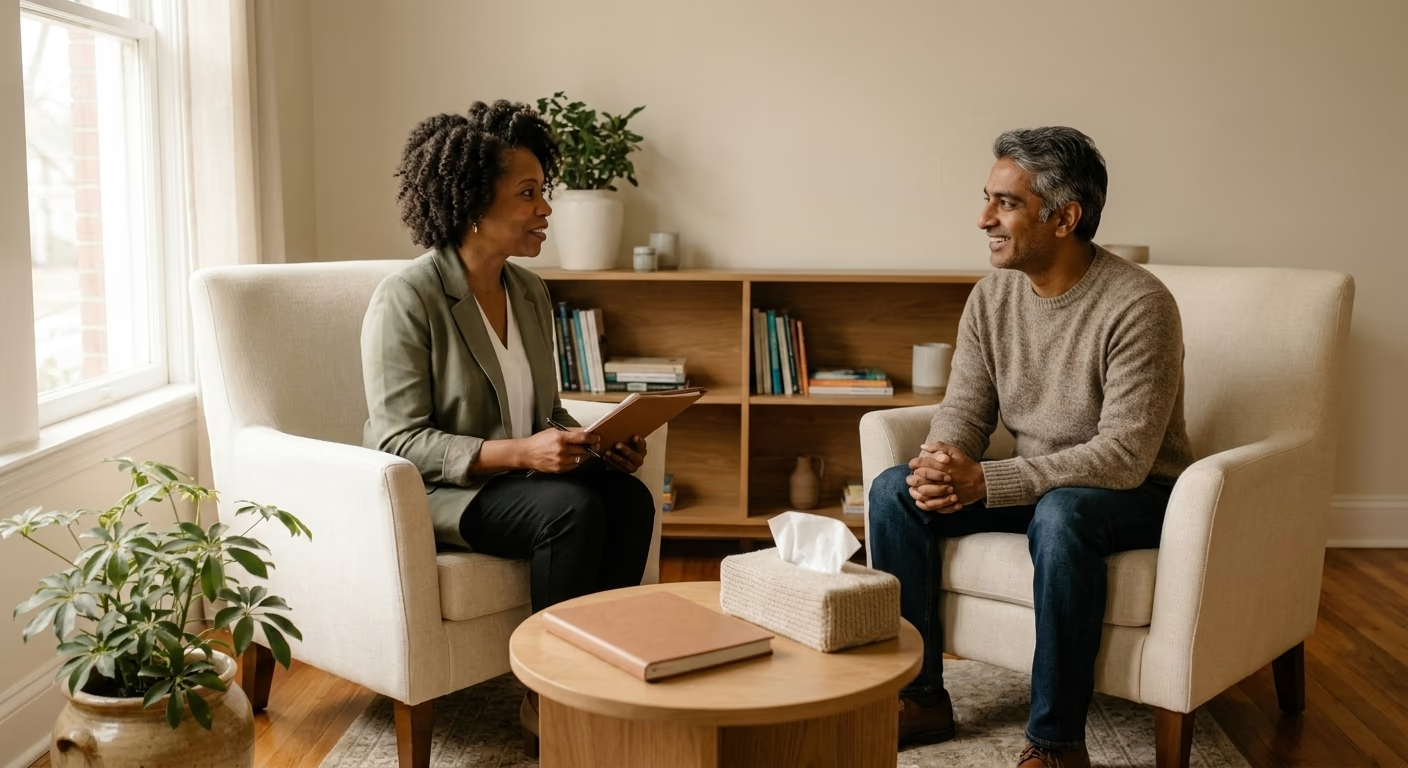
Around 40 million adults in the United States experience anxiety disorders in a given year, making them the most common mental health conditions in the country, and panic disorder is one of them. Anxiety disorders are not simply a matter of brain chemistry, and they are not simply a matter of thinking wrong either; the treatments that work best address both. Maplewood Mental Health Clinic provides psychiatric evaluation and medication management for panic disorder and other anxiety disorders across Essex County. Teresa Omwenga, PMHNP-BC, sees patients aged twelve and older by telehealth and in person. We do not provide therapy of any kind, so this page also explains how to find the therapy side, which for panic is the part with the strongest evidence.
What a panic attack actually is
A panic attack is a surge of intense fear that peaks within about ten minutes and passes within twenty to thirty. The peak is the part that matters clinically: the body's alarm system fires at full volume, floods you with adrenaline, and then, because adrenaline is metabolized quickly, it stops. Nothing you do or fail to do during the attack changes that arc much.
The reason it feels catastrophic is that the fight-or-flight response is designed to save your life from a perceived danger. Heart rate climbs to move blood to the muscles. Breathing speeds up, which lowers carbon dioxide and produces the dizziness and tingling. Digestion shuts down, which is the stomach discomfort. These are the correct responses to a threat, arriving when there is no threat, and the body cannot tell the difference.
Panic attacks often feel overwhelming and can arrive with no trigger at all, sometimes waking people from sleep. That is not evidence that something is more seriously wrong. Nocturnal panic attacks are a recognized part of the condition.
Physical, emotional, cognitive, and behavioral symptoms
The common symptoms fall into four groups, and recognizing them as a set is itself part of treatment.
Physical symptoms: rapid heartbeat or pounding chest, shortness of breath or a feeling of being smothered, chest pain, trembling, sweating, chills or hot flushes, nausea or stomach discomfort, dizziness, numbness or tingling in the hands and face.
Emotional symptoms: intense fear, a conviction that you are dying or losing your mind, and a sense of unreality or detachment from your own body.
Cognitive symptoms: catastrophic interpretation of ordinary physical sensations, racing thoughts, and an inability to reason yourself out of the fear while it is happening.
Behavioral symptoms: fleeing the situation, seeking reassurance, carrying medication as a talisman, and the avoidance behaviors that build up afterward.
The physical symptoms of anxiety this severe are convincing: the chest pain and shortness of breath are why a large proportion of first panic attacks end in an emergency department. That is a reasonable thing to do the first time. Cardiac symptoms deserve a proper look, and once a physical health workup is clear, the same symptoms recurring in the same pattern point to panic rather than to something missed.
Panic attack, panic disorder, and anxiety attack
These get used interchangeably and they are not the same thing.
A panic attack is a single episode. Many people have one, connected to one of the stressful life events everyone eventually has, and never have another.
Panic disorder is the diagnosis when there are repeated unexpected panic attacks plus at least a month of persistent worry about having more of them, or a change in behavior because of them. The second half of that definition is the important half: panic disorder is maintained less by the attacks themselves than by the fear of the next one.
Anxiety attack is not a clinical term. People generally use it for a slower build of anxiety symptoms without the sharp ten-minute peak. It usually points toward generalized anxiety disorder, where ongoing worry runs at a lower intensity for much longer.
The practical difference matters for treatment. Treating panic disorder targets the fear of the sensations. Treating anxiety of the generalized kind targets the constant worry and the content of the thoughts.
How to get out of a panic attack
Nothing stops a panic attack instantly, and that is the first thing worth knowing, because chasing a stop button makes it worse. What follows shortens attacks and, more importantly, stops them from escalating.
Slow the exhale. Breathing exercises work here for a physiological reason: hyperventilation drives the dizziness and tingling. Breathe in for four, out for six or eight. The long exhale is the active part.
Name it. Saying "this is a panic attack, it peaks in ten minutes, it has never harmed me" interrupts the catastrophic loop. This is where evidence-based treatment and self-help overlap most directly.
Stay put if you can. Fleeing teaches the brain that leaving saved you, which strengthens the avoidance behaviors. Riding one out, even once, is worth more than a dozen escapes.
Use grounding. Grounding techniques pull attention outward to the room and away from the body's physical sensations, which is a small piece of managing anxiety rather than a cure for it.
Do not fight it. Trying to force it down adds a second layer of fear on top of the first. Letting it run is counterintuitive and it works.
One caution. Any technique can become a safety behavior — something you believe prevented catastrophe, which quietly teaches you that catastrophe was possible. Use these as tools while you get proper treatment, not as a substitute for it.
What is the 3-3-3 rule for panic attacks?
The 3-3-3 rule is a grounding exercise: name three things you can see, three sounds you can hear, and move three parts of your body. It is widely shared and it is genuinely useful for interrupting the spiral in the moment.
Two honest caveats. There is no formal research base behind the 3-3-3 rule specifically — the evidence supports grounding and attention-shifting in general, not that particular formula. And like any in-the-moment tool it can turn into a safety behavior in panic disorder. Someone who believes the 3-3-3 rule is what keeps them safe has added another thing to depend on.
Use it as one of several relaxation techniques you can reach for while pursuing treatment that resolves the underlying pattern.
What type of doctor should I see for panic attacks?
The short answer: a psychiatrist or a psychiatric nurse practitioner for medication and diagnosis, and a therapist trained in cognitive behavioral therapy for the treatment with the best evidence. Most people with panic disorder end up seeing both.
Start with your primary care doctor if you have not had the physical side checked. Thyroid problems, cardiac arrhythmias, and some medications produce symptoms of anxiety that are indistinguishable from panic, and a medical history and basic workup rule those out. Primary care can also start an SSRI, which many do competently.
See a psychiatric prescriber when the primary care route has not worked, when the picture is complicated by depression or substance use, or when you want someone whose whole practice is this. A psychiatric evaluation takes a full history, sorts panic disorder from the other anxiety disorders such as generalized anxiety disorder and social anxiety disorder, and builds treatment plans around what you actually have rather than the headline symptom. It should also lay out the treatment options honestly, including the ones this practice does not provide.
See a therapist for the treatment that produces lasting change. Directories and your insurer's own portal are the practical route to finding a specialized provider, and the next sections cover both the therapy and the search.
What is the best therapy for panic attacks?
Cognitive behavioral therapy, specifically the panic protocol. It has the strongest evidence of any treatment for panic disorder, it works in roughly 12 sessions, and remission rates are high enough that panic is considered one of the most treatable anxiety disorders.
Three components do the work. Psychoeducation replaces the catastrophic interpretation with an accurate one, so a racing heart stops meaning a heart attack. Cognitive work dismantles the negative thought patterns that turn a sensation into an emergency. And interoceptive exposure, the part most people have never heard of, deliberately provokes the physical sensations — spinning in a chair for dizziness, breathing through a straw for breathlessness, running up stairs for a rapid heartbeat — until the body stops reading them as danger. It retrains fear responses at the level of the body rather than the level of argument, which is why it outperforms reassurance.
Exposure therapy in its more familiar form gradually confronts the situations that have been avoided: the highway, the supermarket, the train. Therapy reliably reduces both the frequency and the severity of panic attacks, and combining it with medication often works better than either alone.
Acceptance and commitment therapy is a reasonable alternative for people who find the exposure framing intolerable. Group therapy for panic has decent evidence and costs less. What matters most is that the therapist can name the protocol they use; general supportive counseling is the weakest of the treatment options for this particular condition. Therapy for panic often opens into wider personal growth, but the panic protocol itself is narrow and mechanical, and that is exactly why it works.
What this practice provides, and what it does not
What we provide: psychiatric evaluation and diagnosis, medication management for panic disorder and other anxiety disorders, coordination with your therapist and primary care doctor, and appointments by telehealth or in person.
What we do not provide: therapy. No individual therapy, no group therapy, no exposure therapy, no intensive programs. No children under twelve. This is not a crisis service.
Teresa Omwenga, PMHNP-BC, is a board-certified psychiatric mental health nurse practitioner. In New Jersey, nurse practitioners prescribe under a joint protocol with a collaborating physician. Treatment plans are built around your history rather than a template, and compassionate care in this context means something specific: nobody is told their symptoms are imaginary, and nobody is rushed through a ten-minute appointment about a condition that has reorganized their daily life. Compassionate care also means being direct about what this practice cannot do, which is why half of this page points elsewhere.
Medication for panic disorder
Medication management for panic disorder starts with an SSRI or an SNRI — sertraline, escitalopram, paroxetine, venlafaxine. These are first-line, they work, and they treat the depression and persistent anxiety that so often sit alongside panic.
One thing about them is specific to panic and worth knowing before you start. SSRIs can cause a temporary increase in anxiety in the first one to two weeks, and people with panic disorder are unusually sensitive to that, because they are already scanning their bodies for signs of something going wrong. The answer is to start at half the usual dose or lower and increase slowly. People often abandon a medication that would have worked because nobody warned them about week one.
Expect six to eight weeks at a therapeutic dose before judging. Once panic is under control, most people stay on the medication for at least a year before discussing a taper, because stopping early has a high relapse rate.
Beyond the first line, buspirone helps excessive worry of the generalized kind more than panic, propranolol takes the edge off the physical symptoms of anxiety for predictable situations such as a presentation, and hydroxyzine is a non-addictive option for occasional use. None of these reduce anxiety symptoms as reliably as an SSRI plus therapy does.
Why benzodiazepines are the wrong long-term answer
Anti-anxiety medications of the benzodiazepine class — alprazolam, lorazepam, clonazepam — stop a panic attack within about twenty minutes, which is why they are so often prescribed and so often requested.
The problems are specific rather than moralistic. Tolerance builds, so the same dose does less. Physical dependence develops within weeks of regular use, and withdrawal from benzodiazepines produces anxiety and can be medically dangerous, which means stopping requires a slow supervised taper. They carry real risk of substance abuse in people with a history of it. And most importantly for panic specifically, they interfere with the learning that makes exposure therapy work — if you take one during exposure, your brain concludes the pill saved you rather than that the sensation was harmless.
There is a legitimate narrow use: a short course early on while an SSRI takes effect, or occasional use for a specific predictable situation. Carrying one every day for two years is not treatment.
The anxiety disorders that travel with panic
Panic rarely arrives alone. Anxiety disorders cluster, and what travels with panic changes the plan.
Agoraphobia. The most common companion and the most disabling. It develops as avoidance behaviors accumulate until the map of safe places shrinks to the house. It is treatable, and it responds to exposure, but it gets harder the longer it runs.
Generalized anxiety disorder. The most common of the anxiety disorders: excessive worry across many domains, most days, for six months or more. Where panic is acute, generalized anxiety disorder is a low constant worry that never fully switches off, and treating anxiety of that kind takes longer than treating panic does.
Social anxiety disorder. Once called social phobia, this is intense fear of being judged. Panic attacks that only happen in social situations usually point here rather than to panic disorder, and the anxiety treatment differs accordingly.
Obsessive compulsive disorder. Intrusive thoughts and compulsions. It needs exposure and response prevention specifically, which general talk therapy does not provide.
Post-traumatic stress disorder. Panic attacks triggered by reminders of a traumatic event are part of PTSD, and treating the panic alone gives partial, temporary relief.
Depression. Present in roughly half of people with panic disorder. It responds to the same first-line medications, which simplifies the choice.
Alcohol and substance use. Alcohol is the most common self-treatment for anxiety symptoms, and rebound anxiety the following day is a reliable driver of the next attack.
Sorting these out is most of what a first evaluation is for. Treating panic without noticing the agoraphobia underneath is the most common way a good plan underperforms.
Finding an anxiety therapist in Livingston NJ
We do not provide therapy, so here is the practical route.
Anxiety therapy in Essex County is mostly cognitive behavioral in orientation, which is good news for panic. Ask every anxiety therapist you contact one question: do you use the CBT panic protocol, including interoceptive exposure? An anxiety therapist who cannot answer that clearly is not the right fit for panic specifically, however good they are generally. The Association for Behavioral and Cognitive Therapies maintains a searchable directory of clinicians trained in these protocols, and the Anxiety and Depression Association of America publishes a similar list.
Then work the logistics. Call the behavioral health number on your insurance card and ask for in-network clinicians within ten miles who are accepting new patients. Psychology Today's directory filters by condition, insurance, and remote availability. Email six rather than one, because response rates are under half.
New Jersey anxiety treatment covers a wide range of prices. Self-pay rates in Essex County generally run $150 to $250 a session for a therapist, with an initial psychiatric evaluation at $250 to $400 and follow-up medication management visits at $100 to $200. Community mental health centers and university training clinics offer sliding scales, and group therapy usually costs a third to a half of individual therapy. Cost is worth settling early, because a plan you abandon in month two does nothing for your quality of life.
Telepsychiatry: anxiety treatment from home in New Jersey
Telehealth matters more for panic than for almost any other condition, because the thing people with panic disorder avoid is leaving the house, and a first appointment that requires driving to an office filters out exactly the people who need it most.
Patients in Livingston NJ can be evaluated, diagnosed, and have medication managed entirely from home. Telepsychiatry services are available across New Jersey, and the research on remote delivery is consistent: outcomes for anxiety disorder treatment by video are comparable to in-person care across the anxiety disorders. Accessible mental health care, in practice, often just means removing the drive.
Therapy works remotely too, including the CBT panic protocol, and interoceptive exposure can be done over video. There is an argument for doing some exposure work in the real settings you have been avoiding, which is worth raising with your therapist once you are underway. Managing anxiety well enough to leave the house is often the first goal rather than an assumed starting point.
In-person visits are still worth prioritizing for a first evaluation if you can manage one, and where safety or a physical examination is a factor. This practice offers both formats; say which you want when you book.
Lifestyle, relaxation training, and what actually moves the needle
Lifestyle adjustments genuinely help manage panic disorder, and they are not a substitute for treatment. Ranked honestly by effect size:
Caffeine. The single highest-yield change. Caffeine can trigger anxiety directly and provoke panic attacks in susceptible people, and cutting it is often the fastest measurable improvement available.
Exercise. Regular aerobic exercise measurably reduces anxiety symptoms and lifts general well-being, with an effect comparable to some medications in mild cases. It also doubles as natural interoceptive exposure: a raised heart rate from running teaches the body that a raised heart rate is safe.
Alcohol. It relieves anxiety in the evening and produces rebound anxiety the next day. Reducing it usually improves things more than adding anything does.
Sleep. Deprivation lowers the threshold for panic. Treating insomnia in its own right is worth doing.
Relaxation training. Progressive muscle relaxation, diaphragmatic breathing, and mindfulness build emotional regulation over weeks. Relaxation techniques and other coping skills are most useful as daily practice rather than as emergency measures, and as coping strategies they work best alongside therapy rather than instead of it. Coping skills lower the baseline; they do not resolve the pattern.
What this adds up to is not a lifestyle cure but a lower baseline, which makes everything else work better and improves overall well-being while the real treatment does its work.
Booking anxiety treatment in Livingston
Maplewood Mental Health Clinic provides psychiatric evaluation and medication management for panic disorder, generalized anxiety disorder, social anxiety, and other mental health conditions to adults, adolescents, and young adults across Essex County, by telehealth and in person. Anxiety disorders are the core of what this practice treats. Teresa Omwenga, PMHNP-BC, sees patients aged twelve and older.
Two things are worth saying plainly at the end. Panic disorder has one of the best outcome records in psychiatry: with proper treatment most people substantially regain control of their everyday life, and many stop having attacks entirely. Anxiety treatment that works does not just reduce symptoms; it returns the parts of daily life that avoidance quietly removed, and overall well-being usually follows. And the longer avoidance runs unchecked, the more of your quality of life it takes, which is the real argument for not waiting. Most people who get proper treatment regain control of the situations they had quietly given up on.
If you also need a therapist, work that search in parallel rather than sequentially. Getting the anxiety treatment started on the medication side does not require having found a therapist first, and the two together are what produce a more fulfilling life on the other side of this rather than a managed version of the same one.
Take the next step.
Start with a free 15-minute call. We will talk through fit, timing, and insurance — there's no obligation to book an evaluation after the call.