ADHD Treatment West Orange, NJ
ADHD Treatment West Orange, NJ: ADHD treatment West Orange NJ residents can get is straightforward once you know the sequence: a proper diagnostic evaluation, then medication if it fits, then the behavioral scaffolding that medication cannot supply. Stimulants improve symptoms in about 70% to 80% of individuals with ADHD, which is a better response rate than almost anything else in psychiatry.
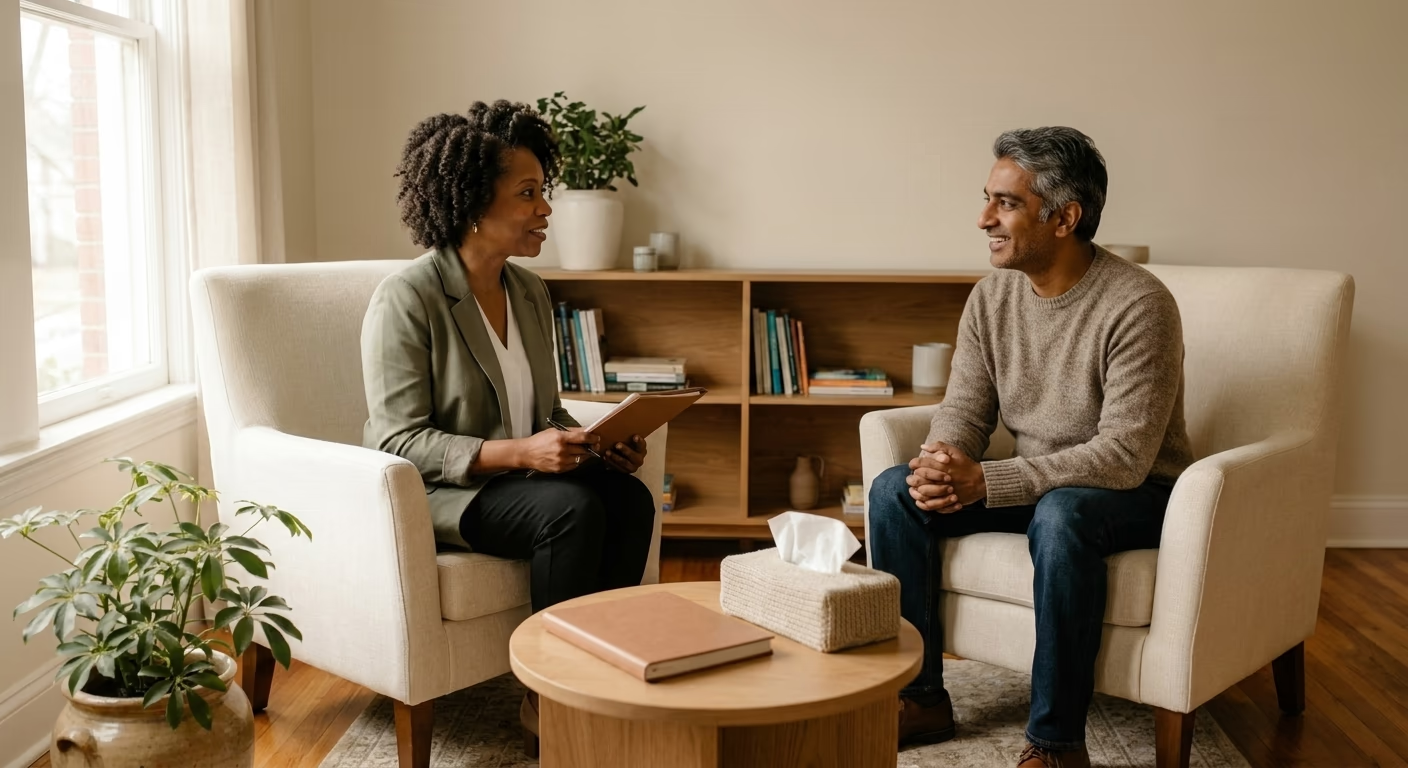
This page covers where to get diagnosed in New Jersey, what the medication actually does, the state rules on stimulant prescribing that catch people out, and how to build a life that works. It is written for adults and adolescents in West Orange NJ and the towns around it.
(908) 201-3904 · Book a free 15-min call→ · Maplewood, ten minutes from West Orange, or by telehealth across New Jersey
Psychiatric evaluation and medication management for ADHD, age 12 and up
In person or by video · Medicaid, NJ FamilyCare, Medicare and 18 insurance plans accepted
We do medication. We do not provide therapy or ADHD coaching — we refer and coordinate
If you are in crisis right now
Call or text 988 any time. For immediate danger, call 911.
West Orange NJ is in Essex County. Psychiatric emergency screening is at Clara Maass Medical Center, Belleville — (973) 844-4357, around the clock, regardless of insurance or ability to pay.
Also: NJ Mental Health Cares 866-202-HELP · NAMI-NJ 866-626-4664 · Peer Recovery Warmline 877-292-5588 · PerformCare 1-877-652-7624 for anyone under 21.
The condition
What ADHD actually is
Attention deficit hyperactivity disorder is a neurodevelopmental condition of the brain's executive function systems — the machinery that handles planning, prioritizing, starting, sustaining and stopping. ADHD affects attention, impulsivity, and activity levels, and it is present from childhood even when nobody noticed until adulthood. Attention deficit hyperactivity disorder shows up in daily life long before it shows up in a clinic.
ADHD affects both children and adults. It is often diagnosed before age 12, and some adults may not be diagnosed until later in life — frequently when their own child is assessed and the description sounds uncomfortably familiar.
The three presentations
Predominantly inattentive. Difficulty maintaining focus, losing things, missing details, appearing not to listen, avoiding tasks that require sustained mental effort. Easily distracted by anything at all. This is the presentation that goes undiagnosed longest, particularly in girls and women, because nothing disruptive ever happens.
Predominantly hyperactive-impulsive. Restlessness, talking over people, difficulty waiting, acting before thinking. In adults the hyperactivity turns inward and becomes a motor that will not switch off rather than a child who cannot sit down.
Combined presentation. Both sets together, and the most common type by a distance.
ADHD symptoms in adults
Chronic lateness and poor time management. Starting six things and completing tasks at a rate of roughly one. Losing keys, phones, entire documents. Interrupting. Emotional reactions that arrive faster and larger than the situation deserves. Hyperfocus on things that are interesting and total paralysis in front of things that are not.
Deficit hyperactivity disorder ADHD symptoms vary by age and individual, which is why a checklist alone never settles it. ADHD symptoms can vary by age and individual in the same person across a decade, and what looks like laziness at thirty was usually undiagnosed ADHD at eight.
ADHD can lead to challenges in school and workplace settings, and by adulthood most undiagnosed people have built a life around avoiding the tasks they cannot start. That avoidance costs more than the ADHD.
What ADHD is not
Not laziness. Not low intelligence — there is no relationship. Not caused by sugar, screens or parenting, though all three affect how visible it is. Not something everyone has a little of: the threshold is symptoms present before age 12, across more than one setting, causing real impairment.
Where can I get diagnosed with ADHD in New Jersey?
Several routes exist and they are not equivalent.
Who can diagnose it
Psychiatrists and psychiatric nurse practitioners diagnose and prescribe, which makes them the one-stop route. Psychologists diagnose and do the formal testing but cannot prescribe in New Jersey. Neuropsychologists do the most detailed testing. Primary care doctors can diagnose and prescribe, and many do it well; many others do it in a twelve-minute appointment, which is not enough.
Psychiatric nurse practitioners are worth a specific mention because they are frequently the shortest route to an appointment in West Orange NJ, where the wait for mental health care of any kind is the real constraint rather than the supply of clinicians. In New Jersey psychiatric nurse practitioners diagnose and prescribe under a joint protocol with a collaborating physician, and for straightforward ADHD the scope is the same.
What a real evaluation involves
Diagnostic evaluations are crucial for tailoring ADHD treatment plans, and a real one takes an hour or more. It covers current symptoms across settings, childhood history — school reports are gold if you can find them — a standardized rating scale such as the ASRS or Conners, a medical history, substance use, sleep, and a deliberate hunt for the conditions that mimic or accompany ADHD.
Collateral information from a partner, parent or old teacher adds more than any questionnaire. Initial ADHD evaluations can be conducted through telehealth, and for adults a video evaluation is as good as an in-person one — with one New Jersey catch covered below.
What about online ADHD tests
A free online screener is a reasonable first step and it is not a diagnosis. The ASRS-v1.1 is the best of them and takes five minutes. Take the result to a clinician rather than to a pharmacy website that will sell you a subscription.
Be careful with the telehealth ADHD services that diagnose and prescribe in the same twenty-minute call. Some are good. Several have been the subject of federal enforcement. A practice that reaches a stimulant prescription before it has asked about your childhood is not doing an evaluation.
Neuropsychological testing: when it is worth it
Formal neuropsychological testing costs $1,500 to $4,000 and is rarely necessary for a straightforward diagnosis. It earns its money when there is a suspected learning disability, when the picture is muddied by a head injury or another condition, when a previous treatment failed inexplicably, or when documentation is required for academic accommodations. Several practices in West Orange NJ and the surrounding towns offer it, and your insurer may or may not treat it as a covered mental health service — ask before you book.
What is the best doctor to see for ADHD?
For medication, a psychiatrist or a psychiatric nurse practitioner. For diagnosis alone, a psychologist is equally qualified. For a child, a developmental pediatrician or a child psychiatrist.
Psychiatrists and psychiatric nurse practitioners
Both diagnose, both prescribe, and both manage the follow-up. Psychiatrists complete medical school and a psychiatry residency; psychiatric nurse practitioners complete a nursing degree, a graduate degree and national certification. A bachelor's degree on its own is not a mental health credential, and the letters after a name on a directory are worth two minutes of checking against the New Jersey licensing database.
The more useful question is not which credential but how the practice runs medication management. ADHD medication needs adjusting, and a prescriber who cannot see you for eight weeks when a dose is wrong is the wrong prescriber regardless of the training.
What to ask on the first call
Do you treat ADHD in adults, and roughly how many patients with it do you see. Is there an experienced team behind the practice or one clinician with a waitlist. Do you prescribe stimulants. What is your follow-up schedule in the first three months. Do you take my insurance. Those five questions, asked of any practice in West Orange NJ, separate a highly trained ADHD prescriber from a generalist faster than any profile page. A highly trained prescriber answers all of them without hedging.
Treatment
ADHD treatment options
ADHD treatment options include psychiatric evaluation, medication management, psychotherapy, and behavioral support. A combined approach of medication and behavioral therapy is recommended for ADHD treatment, and medication management is essential for effective ADHD treatment in most adults.
Stimulant medications
Stimulant medications are commonly prescribed for ADHD and remain first-line. Two families: methylphenidate (Ritalin, Concerta, Focalin) and amphetamine (Adderall, Vyvanse, Dexedrine). Roughly 40% of people respond better to one family than the other, so failing one is not failing the class.
They work within an hour, they work on the day you take them, and they do not need to build up. Stimulants improve symptoms in about 70% to 80% of individuals with ADHD — the highest response rate of any psychiatric medication for any condition.
Side effects: appetite suppression, insomnia if taken late, a rise in heart rate and blood pressure, irritability as the dose wears off. Most are dose-related and most settle. Blood pressure gets checked at every visit, which is part of why medication management requires regular follow-up appointments for effectiveness rather than an annual renewal.
The addiction question, answered plainly: taken as prescribed for genuine ADHD, stimulant medications reduce rather than increase the risk of later substance abuse. Misuse is real and it is a different scenario from treatment.
Non stimulant medications
Non stimulant medications matter where stimulants fail, cause unacceptable side effects, or are inadvisable. Atomoxetine takes four to six weeks and works steadily across the day. Guanfacine and clonidine help with impulsivity, emotional dysregulation and sleep, and are often added to a stimulant rather than replacing it. Bupropion has off-label evidence and is useful where depression sits alongside the ADHD.
Medication management can include both stimulant and non stimulant options in the same plan, and a good treatment plan says in advance what happens if the first agent does not work.
Therapy and behavioral support
Medication turns the volume down on the symptoms. It does not install the systems. That is what therapy is for.
Cognitive Behavioral Therapy is effective for teaching executive functioning skills, and CBT adapted for ADHD targets procrastination, planning and the negative self-talk built up over twenty years of being told to try harder. Behavioral interventions include strategies for organization, self-control, and emotional regulation. ADHD coaching is practical and unregulated, so check the credentials. Group therapy normalizes the condition quickly. Family therapy helps where the household has been fighting about the same undone tasks for years. Therapy can help with ADHD-related challenges like organization in a way no prescription reaches, and the therapy options that work for ADHD are specific ones rather than general supportive conversation. Therapists who advertise ADHD experience are worth calling first; therapists who do not will usually say so honestly if you ask.
Behavior therapy is especially beneficial for children diagnosed with ADHD, and for children under six it is first-line before any medication is considered.
What the combination buys you
Medication alone improves symptoms. Effective treatment of the whole condition needs more than that: medication plus behavioral therapy improves outcomes — grades, employment, relationships, the patient's quality of life across the parts that do not show up on a symptom scale. The combination is what the treatment guidelines recommend and what most people end up doing once the first six months settle.
The New Jersey rules on stimulant prescribing
This trips up more people in West Orange NJ than any other part of ADHD treatment, so here is the current shape of it.
Stimulants are Schedule II controlled substances. Under New Jersey law as amended in 2026, an adult's initial ADHD evaluation may be conducted by telehealth, but an in-person visit is required within 30 days of the first prescription. After that, contact is required at least quarterly, and those quarterly visits may be by video, with at least one in-person visit each year.
In practice this is why so many practices describe it as "New Jersey mandates in-person visits for initial stimulant prescriptions" — some ADHD medications require an in-person visit for initial prescriptions in the sense that you will be in a room within the first month either way. Plan for it.
Two other practical points. Schedule II prescriptions cannot be refilled, so a new prescription is needed each month, and New Jersey requires electronic prescribing. And the national stimulant shortages of recent years are still felt intermittently; call the pharmacy before the last pill, not after.
This is general information rather than legal advice, and the rules change. Your prescriber will tell you what applies to you.
How to get life together with ADHD
The honest framing: medication makes the systems possible, and the systems are still yours to build.
Systems, not willpower
Every workable ADHD strategy shares one feature — it moves the load out of your head and into the environment. Willpower is the resource ADHD is short of, so stop spending it. Managing ADHD symptoms in daily life is a matter of coping skills and infrastructure rather than resolve, and the infrastructure is what survives a bad week.
One calendar, everything in it, with alarms. One capture list for every task, reviewed daily. Visible storage, because out of sight is genuinely out of mind here. Body doubling — working alongside another person, in the room or on a video call — which is the single most reliable trick anyone with ADHD reports.
Time management
Time blindness is the underrated symptom. Clocks in every room. Timers for everything. Estimate how long a task will take, then double it, then write down what it actually took, because the estimate improves with data and not with effort.
Completing tasks
Break the task down until the first step is embarrassingly small, then do only that. Two-minute rule: if it takes under two minutes, do it now rather than adding it to a list you will not read. Finish one thing before starting the next, which is the hardest instruction on this page.
Sleep, movement and food
Sleep is the multiplier — ADHD symptoms and sleep deprivation are close to indistinguishable, and a consistent wake time is worth as much as a dose adjustment. Exercise improves focus measurably for hours afterward. Protein at breakfast steadies the morning, particularly on stimulant medications that suppress appetite later in the day.
None of this replaces treatment. All of it makes treatment work better in everyday life.
What travels with ADHD
ADHD arrives alone in a minority of cases, and what accompanies it changes the plan.
Anxiety. Anxiety disorders are the most common companion. Years of missed deadlines produce a realistic anxiety about the next one, and treating the ADHD often reduces the anxiety more than treating the anxiety does. Where panic attacks are present, note that stimulants can worsen panic attacks in some people and the dose or the agent may need to change.
Depression. Depression is common and frequently secondary — the accumulated result of underperformance relative to ability. Both need treating, and the order matters less than the fact that neither gets left out.
Trauma. Trauma and ADHD look alike from a distance: poor concentration, restlessness, reactivity. A trauma history should be asked about in every ADHD evaluation, because stimulants prescribed into untreated trauma can make the hypervigilance worse.
Bipolar disorder. Rare alongside ADHD and important to exclude, because stimulants can destabilize bipolar disorder. The distinguishing feature is episodes: ADHD is constant, bipolar disorder comes in periods.
Substance abuse. Higher rates in untreated ADHD than in treated ADHD, which is an argument for treatment rather than against it.
Learning disorders, sleep disorders and emotional dysregulation all overlap. Emotional regulation difficulty is not in the formal diagnostic criteria and is one of the most disabling features in real life.
Depression and anxiety together account for most of what arrives alongside adult ADHD, and neither improves much while the ADHD itself is untreated. Treating the ADHD does not cure depression and does not cure anxiety; what it removes is the daily evidence that feeds both. Where depression is severe it gets treated first, and where anxiety is severe the stimulant dose usually starts lower than it otherwise would. Untreated depression and untreated anxiety both blunt the benefit of ADHD medication, which is why behavioral health treatment for ADHD is rarely about ADHD alone.
ADHD in children, teens and young adults
For children, behavior therapy and parent training come first, and for under-sixes they come before medication entirely. School matters: a 504 plan or an IEP provides accommodations — extra time, seating, reduced written load — and a New Jersey school district must evaluate on written parental request. Put the request in writing and date it.
In teens the hyperactivity often fades while the executive function problems get worse, exactly as the academic demands rise. Young adults hit the same cliff at college, where the structure that was holding everything together disappears in one week. Life transitions of that kind are when undiagnosed ADHD usually becomes undeniable.
We treat adolescents from age 12 and up. For children under 12, PerformCare at 1-877-652-7624 is New Jersey's entry point, and a pediatrician or a child psychiatrist is the right first call. Pediatric mental health services in Essex County are stretched, so start that call early.
For families
Families get told to be consistent and are rarely told what that means.
Externalize, do not nag. Alarms, lists and visible calendars do the reminding, so the relationship does not have to.
Praise the start, not the finish. Starting is the disabled function. Rewarding it works better than rewarding completion.
Separate the condition from the character. Forgetting is a symptom. Framing it as not caring is the single most common source of damage to relationships around ADHD, and relationships are usually where the cost of untreated ADHD is paid first.
Get your own support. Parenting a child or an adolescent with ADHD is exhausting, and parent training programs measurably help — parents of adolescents benefit as much as parents of small children, which surprises people. Families who do them report better outcomes for everyone in the house.
Where can I find ADHD support groups?
CHADD is the national ADHD organization and maintains a directory of local chapters and groups, including in New Jersey. ADDA runs virtual peer support groups for adults, which suits a condition where getting to a building at a fixed time is part of the problem. NAMI New Jersey runs free support groups and family education across Essex County.
CHADD and ADDA both cover every region of the country, so the same two directories work wherever you are searching from. The groups this page can vouch for are the New Jersey ones, and NAMI's Essex County offerings are the closest to West Orange NJ.
ADHD care across West Orange NJ
Where to look
Psychology Today lets you filter psychiatrists and therapists in West Orange NJ by ADHD, insurance and telehealth. Your insurance company's directory is the most reliable in-network filter and is frequently out of date, so call to confirm. CHADD's professional directory lists clinicians who have declared ADHD as a specialty, which narrows a West Orange NJ search faster than a general mental health filter does. Your primary care doctor is a reasonable referral source and already holds the medical history.
Behavioral health services in West Orange NJ are plentiful at the therapy end and thinner at the prescribing end, and the wait for a psychiatric appointment is the usual bottleneck for patients here. Several practices with New Jersey offices run telehealth statewide, which widens the pool considerably — a clinician licensed in New Jersey can see a patient in West Orange NJ or in Jersey City equally well, and practices licensed in multiple states can follow patients who travel.
One reason the sorting is hard: behavioral health is an umbrella term, and in West Orange NJ it covers a wide spread of services — prescribing practices, therapy practices, testing services, coaching, and the behavioral health departments attached to the hospitals. Patients arriving with mental health concerns rarely know which of those they need, and the sorting costs more time than the treatment does. If you take one shortcut, take this one — decide first whether you need a diagnosis, a prescription, or systems, because those are three different services and almost nobody sells all three.
Behavioral health services for first responders and shift workers are worth asking about specifically, because the sleep disruption that comes with those jobs makes ADHD symptoms markedly worse and changes which medication makes sense. Several behavioral health practices in New Jersey run programs built for them, and patients in those jobs should say so at the first appointment rather than at the fourth.
Where the rest of the system fits
Private psychiatric practices handle evaluation and medication management, and this practice is one of them. Neuropsychological testing services handle formal assessment. ADHD coaches and therapists handle the systems. Community mental health centers in Essex County take Medicaid and run sliding scales, and for a good many patients they are the only mental health services that answer the phone the same week. School child study teams handle accommodations at no cost, and their services are a legal entitlement rather than a favor.
A multidisciplinary approach is what practices call the combination of all this. What it means concretely is that your prescriber and your therapist talk to each other, and you can test that with one question before you book.
A note on where people actually go. Patients in West Orange NJ typically try three routes before landing somewhere that holds: the primary care doctor, an online ADHD service, and then a local psychiatric practice. The first is fine for a start and thin for maintenance. The second is fast and uneven. The third is the one that lasts, and in West Orange NJ the wait is the price of it. Mental health issues of every kind hit the same bottleneck here, and ADHD patients feel it more than most, because a gap in a Schedule II prescription is not a small inconvenience.
Three practical questions for any practice in West Orange NJ. Ask about the follow-up schedule before you book rather than after. Ask whether medication management is run by the same clinician each time. And ask what happens in August, because summer coverage gaps are where ADHD patients in West Orange NJ most often fall out of treatment. The mental health services here are good at starting people and less good at keeping them, and the practices that keep patients are the ones worth waiting for.
Cost, insurance and telehealth
Insurance
Mental health treatment is an essential health benefit under the ACA, and federal parity law requires coverage no more restrictive than for physical conditions. Verify in-network status and any prior authorization before the first appointment rather than after it — stimulants in particular often need authorization.
We accept Medicaid, NJ FamilyCare, Medicare and 18 commercial plans, and we verify your specific plan on the free call. Since January 2025 New Jersey has run NJ FamilyCare behavioral health through managed care, so the card in your wallet now decides your network. Generic stimulants are inexpensive; the branded long-acting versions are not, and a prior authorization or a manufacturer coupon usually closes the gap.
Telehealth and online therapy
Telehealth allows ADHD treatment via virtual appointments, and telehealth appointments for ADHD are HIPAA-compliant and safe when run on proper platforms. Online therapy for ADHD can be as effective as in-person sessions, and for a condition where the drive to an appointment is itself a barrier, that matters more than usual.
The New Jersey stimulant rules above are the limit: some appointments have to be in person, and the first month is one of them.
Many clinics offer free consultations for ADHD treatment. Free consultations typically last around 15 minutes, free consultations help assess patient-clinician fit, and some practices provide free consultations via telehealth. Ours is fifteen minutes by phone or video and involves no diagnosis and no prescribing — it exists so you can find out whether this is the right place before paying for an evaluation.
The practice
How this practice works
What we do: psychiatric evaluation, diagnosis, medication management, psychoeducation, coordination with your therapist and your GP, and continuing care from one clinician. This practice focuses exclusively on the psychiatric side, and that focus is deliberate.
What we do not: therapy of any kind, individual therapy, group therapy, family therapy, ADHD coaching, neuropsychological testing, substance abuse treatment, crisis services, or children under 12.
The first appointment
About an hour: current symptoms across settings, childhood history, school history, medical history, medications, substances, sleep, and the conditions that travel with ADHD. It produces a working diagnosis and a written care plan. In person in Maplewood or by video, with the in-person requirement handled inside the first month if a stimulant is started.
Continuity
The clinician who starts the medication is the clinician adjusting it in three years. In ADHD that matters because the first agent is often not the last one, and the person who remembers that methylphenidate caused the headaches makes a better second choice.
A supportive environment
Treating patients with ADHD means accepting that appointments get missed and forms arrive late — that is the condition, not disrespect. We aim to provide compassionate care in the only sense that means anything: nobody here will lecture you for forgetting, and nobody will make you re-explain the whole history because a form went missing. Practices across West Orange say they provide compassionate care; the test is whether the third missed appointment is treated as a symptom or as a character reference. Personalized care means the plan is built around how your week actually runs, and clients feel heard when the plan survives contact with a real Tuesday.
Getting here
1585 Springfield Avenue, Maplewood, NJ 07040 — about ten minutes from most of West Orange NJ, free parking directly outside, easy from Pleasant Valley Way, Northfield Avenue and Prospect Avenue. Call (908) 201-3904, Mon–Fri 9am–5pm, or book the free call online. There is no intake form to complete first, which is deliberate for this particular condition.
What treated ADHD feels like
People expect a personality change and get something quieter.
The gap closes. The distance between intending to do a thing and doing the thing narrows. That is the single most reported change and it arrives on the first good dose.
The noise drops. Many adults describe the first hour on the right medication as the first silence they can remember. Some cry. It is not unusual.
The emotions settle. Reactions still happen, at a size the situation warrants.
Relationships change. Less lateness, fewer forgotten things, fewer arguments that were never really about the dishes.
What does not change: you are still you, and the interests, the speed and the jumps between ideas stay. Treated ADHD is not a flatter person. Healing here is mostly the healing of the twenty years of being told you were careless, and that part takes longer than the medication does. Emotional wellness comes back slowly as the evidence accumulates that the problem was never effort, and emotional wellness of that kind is the part families notice first.
Mental well being in this condition is measured in unremarkable weeks: the bills paid on time, the work submitted, the Saturday that went the way it was meant to. Well being of that ordinary kind is a reasonable expectation, and most patients reach that level of well being inside a year of starting treatment.
The first step
Untreated ADHD costs more than almost any condition of its severity, mostly in the form of opportunities that quietly did not happen. Treated ADHD has one of the best response rates in medicine. The gap between those two sentences is usually one evaluation that nobody ever booked.
The free 15-minute call covers fit, cost and insurance — no diagnosis, no prescribing, no pressure. If what you need is testing, a therapist or a coach rather than a prescriber, we will say so and point you at one.
Maplewood Mental Health Clinic · 1585 Springfield Avenue, Maplewood, NJ 07040 · (908) 201-3904 · serving West Orange NJ and Essex County · Book a free 15-min call→ · In crisis: 988
Take the next step.
Start with a free 15-minute call. We will talk through fit, timing, and insurance — there's no obligation to book an evaluation after the call.