Elizabeth, NJ · Union County · Psychiatric care for older adults, telehealth across New Jersey
Geriatric Mental Health Elizabeth, NJ
Geriatric Mental Health Elizabeth, NJ: Depression after 65 is not a normal part of aging. Neither is anxiety, and neither is a personality that suddenly changed. Geriatric psychiatry exists because late-life psychiatric conditions present differently, interact with medical illness, and respond to different doses than they do at 40 — and because they are treatable when somebody actually looks. Geriatric psychiatry is also the branch of mental health care where the geriatric population is most often under-served, which is why this page is as much a map of Union County services as it is a description of ours.
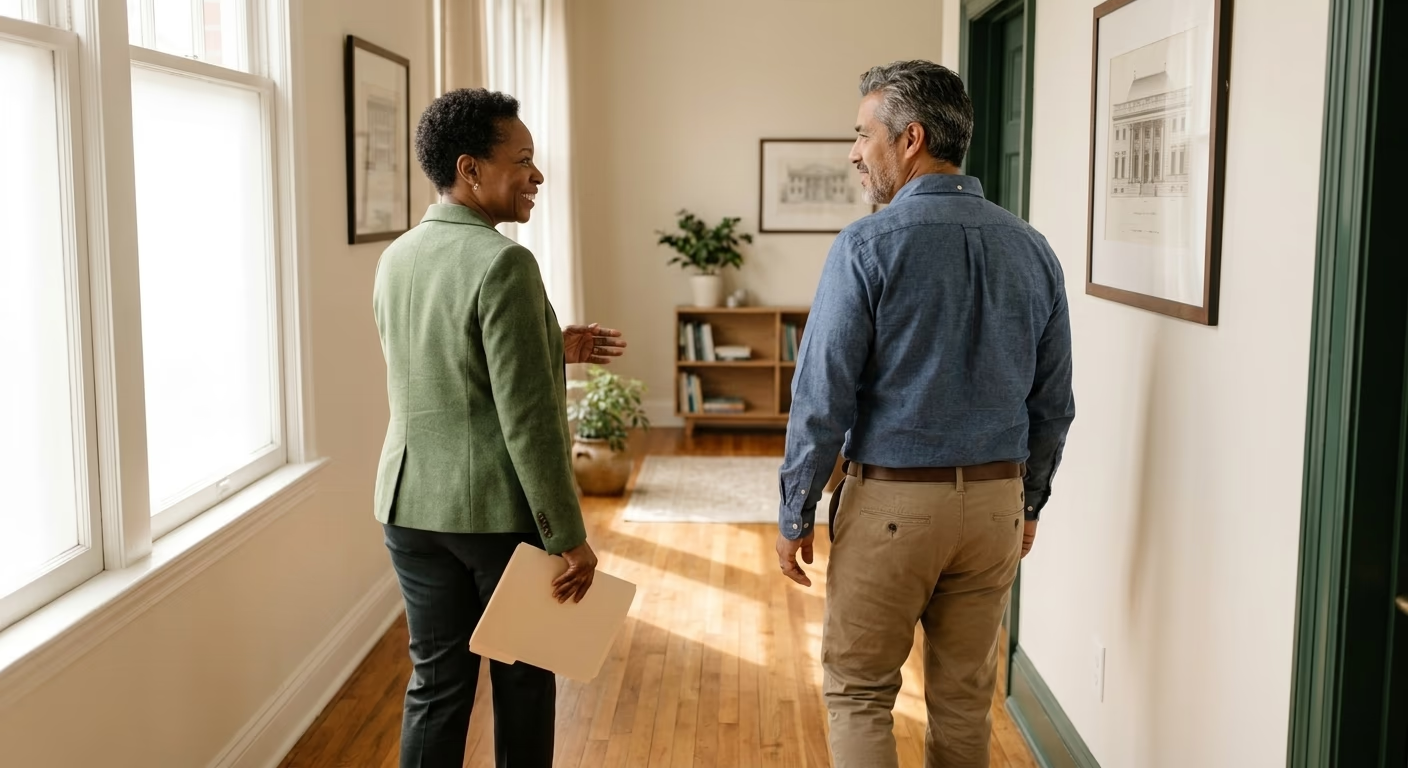
Geriatric mental health Elizabeth NJ families can start with a free 15-minute call. Telehealth across New Jersey, with the Maplewood office for in person visits.
Conservative, age-adjusted prescribing
Medication review across every prescriber
Medicare, Medicaid and 18 insurance plans accepted
If you need help right now
Call or text 988, free and confidential, any time. For immediate danger, call 911. Elizabeth is in Union County, and the county's psychiatric emergency screening service is at Trinitas Regional Medical Center, 655 East Jersey Street, Elizabeth — (908) 994-7131, around the clock. Trinitas is the medical center most Elizabeth residents will be taken to, and it is in the city rather than a county away. Knowing which center your relative would go to, before the night you need it, is worth ten minutes now.
If you are worried about the safety of an older adult who is being neglected or exploited, New Jersey's Adult Protective Services operates in every county and can be reached through the county office.
The thing most often missed
Depression in later life does not look like depression.
Ask a 78-year-old whether they feel sad and the answer is frequently no. Ask whether they still enjoy anything, whether they are sleeping, whether they have stopped calling people, and a different picture appears.
Late-life depression presents through the body and through cognition more than through mood. Aches with no medical explanation. Appetite and weight loss. Fatigue that no amount of rest touches. Preoccupation with health. Irritability rather than tearfulness. Withdrawal from the things that used to structure a week. And, critically, memory and concentration problems severe enough to look like early dementia — a presentation clinicians call pseudodementia, which improves when the depression is treated.
That last point is why an evaluation matters. Cognitive decline that is actually depression is reversible. Depression that is actually early dementia needs a different plan. Telling them apart takes a proper assessment rather than an assumption, and getting it wrong in either direction costs years.
The risk that does not get discussed. Older men are among the individuals at highest risk of suicide of any group in the United States, and seniors overall are under-recognized in that statistic. The warning signs are quieter too — giving things away, settling affairs, a sudden calm after a low period. Most had seen a doctor within weeks. Asking directly does not plant the idea; it is the only way to find out.
What we treat
Psychiatric care for older adults, condition by condition.
Depression, including the first episode after 70, which is common and frequently missed.
Anxiety, which often arrives with a medical diagnosis, a fall, or the loss of driving.
Grief that has stopped moving. Bereavement is not an illness, but prolonged grief that is still disabling after a year is, and it responds to treatment.
Sleep disorders, which change with age in ways that are normal and in ways that are not.
PTSD, including trauma from fifty years ago reactivated by retirement, bereavement or a hospital admission. Late-life PTSD is routinely dismissed as personality.
Bipolar disorder in an aging patient, where lithium monitoring becomes more important rather than less.
OCD carried for decades, often for the first time named.
ADHD diagnosed late, which happens more often than people expect and explains a great deal retrospectively.
Behavioral changes in dementia — agitation, sleep reversal, suspicion — where the first question is always what changed, not which medication to add. Pain, constipation, infection and a new medication cause more behavioral change in dementia than the dementia does.
Individuals struggling with any of these are frequently told, by well-meaning people, that it is just their age. It is important to say clearly that it is not, and that the challenges of later life do not require accepting a psychiatric condition on top of them. Late-onset ADHD recognition and long-carried OCD are two more examples of conditions that get dismissed this way, as is bipolar disorder presenting differently after 65.
What we do not treat: we do not diagnose or manage dementia itself. That belongs with neurology, geriatric medicine or a memory center. We work alongside those specialists on the psychiatric symptoms.
The medication problem
Six prescribers, one patient.
The single most valuable thing in geriatric psychiatry is not a new prescription. It is a complete medication review.
A typical older adult in this area sees a primary care physician, a cardiologist, an endocrinologist and one or two others, plus whatever a hospital admission added. Nobody holds the whole list. Interactions accumulate, anticholinergic burden builds, and the confusion or low mood that brings someone to a psychiatric appointment turns out to be the seventh medication rather than a new condition.
What we do at the first visit. Every prescription, every over-the-counter product, every supplement, laid out together. Then the questions: what is this still for, is the dose still right at this age, and what is the combined effect on cognition and falls?
Age-adjusted prescribing. Start low and go slow is not a cliché in geriatric patients; it is the standard of care. Kidney and liver clearance slow, body composition changes, and a dose that was correct at 50 can be twice what is needed at 80.
Medications we look hard at. These are the medications that most often cause the problem they were meant to fix. Benzodiazepines, which raise fall and confusion risk substantially in older adults and are on every deprescribing list there is. Anticholinergics, which are in far more products than people realize, including over-the-counter sleep aids. Certain antidepressants that carry sodium risks. Antipsychotics in dementia, which carry a boxed warning and are used only where the alternative is worse, at the lowest dose, for the shortest time, reviewed constantly.
Deprescribing is treatment. The fastest way to address confusion, falls and low energy in an older patient is frequently to remove something rather than add it. Stopping something that is no longer helping is as much a clinical act as starting something new, and in this age group it is frequently the one that produces the biggest improvement.
Medication management here means all of this rather than a refill; it is one part of care in addition to assessment and coordination with other specialists, and it is the reason the first appointment is long. Good medication management in this age group is measured in medications removed as often as in medications added, and the medication management visit is where the real work happens rather than at the first evaluation.
How Elizabeth patients are seen
Telehealth, and why it fits this group.
Telehealth anywhere in New Jersey, including Elizabeth and the rest of Union County.
In person at 1585 Springfield Avenue, Maplewood, NJ 07040 — roughly nine miles north of Elizabeth, free on-site parking.
Phone (908) 201-3904, Mon–Fri 9am–5pm.
Telehealth removes the two barriers that keep older adults out of psychiatric care: transport and stamina. A great many people in this age group no longer drive, depend on a family member to take a morning off, or find a half-day round trip genuinely exhausting. A video visit from a familiar living room removes all of that, and Medicare covers telehealth mental health services.
Practical notes for families. A tablet on a stand works better than a phone held up. A family member can join from another location on the same call. A regular spot with decent light and no television in the background makes a surprising difference. If the video fails we finish by phone rather than rescheduling.
If your relative is in assisted living or a nursing home, a member of the facility staff can often set up the call, and the staff observations are genuinely useful clinical information. We ask for them with consent.
On Spanish and other languages. Elizabeth has a large Spanish-speaking population, and an older adult who has spoken English for fifty years may still find that the precise words for their mood come more easily in Spanish. Ask on the free call. If we cannot provide care in the language you need, we will say so plainly and point you toward Union County providers who can rather than proceeding badly.
For families
When you are the one who noticed.
Most calls about an older adult come from a daughter, a son or a spouse. That is normal and it is the right instinct.
What to bring to the conversation. Specific changes with rough dates. Not "Mom seems down" but "she stopped going to church in March, she has lost weight since then, and she called me three times last week about the same bill." Specifics are what an evaluation works with.
What to expect. The older adult has to consent to care. Where they have capacity, the decision is theirs, and no amount of family concern overrides it. What you can do is arrange the appointment, sit in with their permission, and make it easy to say yes.
Resistance is common and usually not stubbornness. For many people in this generation, psychiatric care carried real stigma for most of their life. Framing it as a medication review or as a conversation about sleep gets further than framing it as mental health care. That is not a trick; it is meeting someone where they are.
On caregiver strain. A wife watching her husband change, or a daughter managing two households, carries a load that rarely gets named. We do not provide family therapy or counseling, and counseling for caregivers is a referral rather than a service here. But we will say plainly when the caregiver is the one who needs support, because support for the caregiver is frequently what improves the patient's outcome. Caregiver counseling and respite programs both exist through Union County's aging services, both are free or low-cost, and most families never hear about them.
Where to find local help. These services exist for exactly this and cost nothing to ask about. The Eldercare Locator, a free federal service at 1-800-677-1116, connects callers to aging services in their own county. Union County's Division on Aging and the statewide Aging and Disability Resource Connection cover benefits screening, in home services, transport, adult day programs and caregiver support. Senior centers across the county run congregate meals and social programs, and social isolation is a genuine risk factor for late-life depression rather than a soft one — a senior center two mornings a week is a real intervention.
The local map
Senior mental health services in Union County.
Nobody hands Elizabeth families a map of what exists, so here is one. These are the kinds of services older residents in this county can actually reach.
Hospital-based care. Trinitas Regional Medical Center in Elizabeth runs behavioral health services and the county's emergency screening. For acute presentations that is the right center, and it is local.
Community mental health services. Union County community providers offer evaluations, counseling and medication management on a sliding scale. Community programs of this kind see a great many seniors and are the right call when cost is the barrier.
Aging services. The Union County Division on Aging and the statewide Aging and Disability Resource Connection handle benefits screening, in home support, transport and caregiver programs. The Eldercare Locator, 1-800-677-1116, is the free federal front door to all of it and will route you to the right county office.
Senior centers and adult day programs. Senior centers across the county run meals, education classes and social programming for seniors; an adult day center provides structured daytime care and gives a caregiver a genuine break. Isolation is a real risk factor for late-life depression rather than a soft one, and both of these address it directly — better than a prescription does. For seniors living alone, two mornings a week at a senior center is a genuine clinical intervention rather than a pleasant extra, and seniors who go consistently report better sleep and mood without anyone prescribing anything. Plenty of seniors who try one keep going. Access is usually free or nearly free, and a phone call is all it takes to schedule a first visit.
In home services. Home health aides, visiting nurses and home-delivered meals keep people living at home longer. A home assessment is frequently more useful than another specialist appointment.
Private outpatient psychiatry. This practice and others like it. Shorter waits than hospital systems, continuity a large group cannot match, and no crisis capacity — which we say plainly rather than discovering together at a bad moment. Providers in this tier vary widely in how much geriatric experience they actually have, so it is worth asking; not every outpatient provider adjusts doses for age, and the ones who do not are where avoidable falls come from.
Telehealth platforms. A national platform can be a fast route to an appointment, though continuity is usually the trade. For an older client, seeing the same clinician every time matters more than it does at 30, and a client in this age group rarely benefits from starting over with somebody new. A platform that rotates providers is a poor fit here whatever the waiting time.
Memory services. For a suspected dementia, a memory center or a neurologist rather than a psychiatric practice. We coordinate; we do not duplicate.
Between those, most of what an older adult in Elizabeth NJ needs exists somewhere in the county. The problem is almost never that no service exists. It is that nobody told the family which door to knock on, and by the time they find it a year has gone. Senior services in this county were designed for people who already know how to ask for them, and that leaves out exactly the individuals who need them most. Access to the right service is worth more than access to any particular clinician, and a call to the aging services line is usually a faster route to help than a wait for a psychiatric appointment.
Who provides this care
Geriatric psychiatrists, and who else can do it.
Geriatric psychiatry is a recognized subspecialty in mental health care: a psychiatrist who completed additional fellowship training in the mental health of older adults. Geriatric psychiatrists are excellent and there are not many of them; geriatric psychiatry fellowships produce a small number of clinicians each year, and demand outruns supply everywhere. In a state this size the number of fellowship-trained geriatric psychiatrists taking new Medicare patients is small, and waits are long.
What that means in practice. Most late-life psychiatric care in New Jersey is delivered by general psychiatrists, psychiatric nurse practitioners and primary care physicians rather than by fellowship-trained specialists in geriatric psychiatry. That is not a scandal — it is a workforce reality — and the quality depends on whether the clinician actually adjusts for age.
What this practice is. Teresa Omwenga is a Board-Certified Psychiatric Mental Health Nurse Practitioner, not a geriatric psychiatrist and not a physician. She treats older adults as a substantial part of the practice, prescribes conservatively, reviews the full medication list, and coordinates with primary care. For straightforward late-life depression, anxiety, sleep and grief, that is appropriate care. Where a case is complex — rapid cognitive decline, a complicated dementia picture, treatment-resistant illness, or the need for ECT — geriatric psychiatrists and geriatric medicine specialists are the better fit and we say so and refer rather than keeping the case.
There is no team here and no intake staff. Where a hospital gives you a team and a phone tree, this gives you one person — and a team is the better answer for complex cases, which is exactly why we refer them. One clinician, the same one each time, which in a group of patients who repeat their history to somebody new every few months is worth a great deal.
What an evaluation involves
Assessments, and what they determine.
The first visit runs 60 to 90 minutes.
History, including a collateral account from family where the patient consents. In this age group collateral is frequently the most informative part.
Cognitive screening, using a brief standardized instrument, to determine whether what looks like depression has a cognitive component and to establish a baseline for comparison later.
Depression and anxiety assessments, using scales validated in older adults, repeated at follow-up so change is measured rather than remembered. These evaluations are designed for this age group specifically, and evaluations built for 40-year-olds miss a great deal in geriatric patients.
Medical review: thyroid, B12, vitamin D, kidney function, medication list. Several treatable medical conditions present as psychiatric illness in this group, and skipping the workup is how they get missed. Medications prescribed elsewhere get reviewed here as a matter of course, because nobody else is doing it.
Function: what a typical day looks like, whether they are still cooking, driving, managing money and taking medications correctly. Function is the measure that matters.
Safety: falls, driving, firearms in the home, and suicidal thinking, asked directly.
Then the plan, discussed rather than announced, with the family included where the patient wants them there.
Cost and insurance
What gets verified before the first visit.
Free 15-minute call — no charge, no obligation, no insurance billing.
Initial psychiatric evaluation — $210, about 90 minutes.
Follow-up visit — $130, about 30 minutes.
We accept Medicare, New Jersey Medicaid and most major insurance plans used in the state — Horizon Blue Cross and Blue Shield, Aetna, Cigna and Evernorth, Oscar Health and UnitedHealthcare among the eighteen listed on our main page. Medicare Advantage plans differ from Original Medicare on network and telehealth rules, so we check your specific plan on the free call before anything is billed.
If your plan is not listed, ask about a superbill or the sliding scale, where self-pay rates drop 20% to 50%. For older adults on fixed incomes, ask also about NJ PAAD and Senior Gold, the state pharmaceutical assistance programs, which can reduce medication costs substantially and which a great many eligible people never apply for.
How Teresa works
Compassionate care, without condescension.
Teresa Omwenga is a Board-Certified Psychiatric Mental Health Nurse Practitioner treating adolescents, adults and older adults across New Jersey. She is not a psychiatrist; in New Jersey, psychiatric nurse practitioners diagnose and prescribe under a joint protocol with a collaborating physician.
Compassionate care for an older patient means specific things. Talking to the patient rather than about them while they are in the room. Not raising your voice at someone whose hearing is fine. Taking a seventy-year history seriously rather than treating a long life as a preamble. Allowing enough time that nobody feels rushed through the part that is hard to say.
It also means being straight about what treatment can and cannot achieve. Some things improve a great deal — depression, anxiety, sleep, and the confusion that comes from a bad medication combination. Some things do not, and dementia is one of them. Saying so honestly, early, is more useful than optimism, and families generally say afterwards that the honesty was what gave them peace of mind rather than what took it away.
Quality of life is the goal, not a symptom score. An older adult who is eating, sleeping, seeing people and interested in the day has good outcomes whatever the scale says, and individuals in this group judge treatment by exactly that rather than by a number.
Common questions
Things Elizabeth families ask
Is depression just part of getting older?
No. It is common in later life and it is not normal aging. It responds to treatment at any age, and treating it frequently improves memory, appetite and physical health at the same time.
Could this be dementia instead?
Sometimes, and sometimes it is depression imitating dementia. A proper assessment distinguishes them, and getting it right changes everything that follows.
Do you treat dementia?
Not the dementia itself — that belongs with neurology or geriatric medicine. We treat the psychiatric symptoms that come with it and coordinate with the memory specialists.
Will you just add another pill?
Frequently the opposite. A full medication review often means stopping something rather than starting something, and that is a legitimate treatment in this age group.
Can my parent be seen by telehealth?
Usually yes, and Medicare covers telehealth mental health services. A family member can help set up the call, schedule it around their own work, and join it with consent.
My mother refuses to go. What do I do?
Start with the free call yourself. We can talk through how to approach it, and framing it as a medication review or a sleep conversation gets further than framing it as psychiatry.
Do you take Medicare?
Yes, along with New Jersey Medicaid and most major plans. We verify your specific plan before anything is billed, and we can schedule the evaluation once that is clear.
Can you see someone in a nursing home?
By telehealth, yes, where the facility can support the call. Staff observations are welcome with consent.
A first step
Late-life psychiatric conditions are among the most treatable in medicine and among the most often missed, and the gap between those two facts is where most of the avoidable suffering sits.
The free 15-minute call covers fit, cost and insurance, with no obligation. If this is not the right place, we will say so and tell you where to look in Union County. It is a short step, it costs nothing, and it is a better first step than another year of wondering. Elizabeth NJ residents can book it today, and families are welcome to make the call today on a relative's behalf to ask what the options are.
Maplewood Mental Health Clinic · 1585 Springfield Avenue, Maplewood, NJ 07040 · (908) 201-3904 · serving Elizabeth NJ and Union County by telehealth
If you are in crisis, call or text 988. Union County screening: Trinitas Regional Medical Center, (908) 994-7131. Emergency: 911.Elizabeth, NJ · Union County · Psychiatric care for older adults, telehealth across New Jersey
Geriatric Mental Health Elizabeth NJ
Depression after 65 is not a normal part of aging. Neither is anxiety, and neither is a personality that suddenly changed. Geriatric psychiatry exists because late-life psychiatric conditions present differently, interact with medical illness, and respond to different doses than they do at 40 — and because they are treatable when somebody actually looks. Geriatric psychiatry is also the branch of mental health care where the geriatric population is most often under-served, which is why this page is as much a map of Union County services as it is a description of ours.
Geriatric mental health Elizabeth NJ families can start with a free 15-minute call. Telehealth across New Jersey, with the Maplewood office for in person visits.
Conservative, age-adjusted prescribing
Medication review across every prescriber
Medicare, Medicaid and 18 insurance plans accepted
If you need help right now
Call or text 988, free and confidential, any time. For immediate danger, call 911. Elizabeth is in Union County, and the county's psychiatric emergency screening service is at Trinitas Regional Medical Center, 655 East Jersey Street, Elizabeth — (908) 994-7131, around the clock. Trinitas is the medical center most Elizabeth residents will be taken to, and it is in the city rather than a county away. Knowing which center your relative would go to, before the night you need it, is worth ten minutes now.
If you are worried about the safety of an older adult who is being neglected or exploited, New Jersey's Adult Protective Services operates in every county and can be reached through the county office.
The thing most often missed
Depression in later life does not look like depression.
Ask a 78-year-old whether they feel sad and the answer is frequently no. Ask whether they still enjoy anything, whether they are sleeping, whether they have stopped calling people, and a different picture appears.
Late-life depression presents through the body and through cognition more than through mood. Aches with no medical explanation. Appetite and weight loss. Fatigue that no amount of rest touches. Preoccupation with health. Irritability rather than tearfulness. Withdrawal from the things that used to structure a week. And, critically, memory and concentration problems severe enough to look like early dementia — a presentation clinicians call pseudodementia, which improves when the depression is treated.
That last point is why an evaluation matters. Cognitive decline that is actually depression is reversible. Depression that is actually early dementia needs a different plan. Telling them apart takes a proper assessment rather than an assumption, and getting it wrong in either direction costs years.
The risk that does not get discussed. Older men are among the individuals at highest risk of suicide of any group in the United States, and seniors overall are under-recognized in that statistic. The warning signs are quieter too — giving things away, settling affairs, a sudden calm after a low period. Most had seen a doctor within weeks. Asking directly does not plant the idea; it is the only way to find out.
What we treat
Psychiatric care for older adults, condition by condition.
Depression, including the first episode after 70, which is common and frequently missed.
Anxiety, which often arrives with a medical diagnosis, a fall, or the loss of driving.
Grief that has stopped moving. Bereavement is not an illness, but prolonged grief that is still disabling after a year is, and it responds to treatment.
Sleep disorders, which change with age in ways that are normal and in ways that are not.
PTSD, including trauma from fifty years ago reactivated by retirement, bereavement or a hospital admission. Late-life PTSD is routinely dismissed as personality.
Bipolar disorder in an aging patient, where lithium monitoring becomes more important rather than less.
OCD carried for decades, often for the first time named.
ADHD diagnosed late, which happens more often than people expect and explains a great deal retrospectively.
Behavioral changes in dementia — agitation, sleep reversal, suspicion — where the first question is always what changed, not which medication to add. Pain, constipation, infection and a new medication cause more behavioral change in dementia than the dementia does.
Individuals struggling with any of these are frequently told, by well-meaning people, that it is just their age. It is important to say clearly that it is not, and that the challenges of later life do not require accepting a psychiatric condition on top of them. Late-onset ADHD recognition and long-carried OCD are two more examples of conditions that get dismissed this way, as is bipolar disorder presenting differently after 65.
What we do not treat: we do not diagnose or manage dementia itself. That belongs with neurology, geriatric medicine or a memory center. We work alongside those specialists on the psychiatric symptoms.
The medication problem
Six prescribers, one patient.
The single most valuable thing in geriatric psychiatry is not a new prescription. It is a complete medication review.
A typical older adult in this area sees a primary care physician, a cardiologist, an endocrinologist and one or two others, plus whatever a hospital admission added. Nobody holds the whole list. Interactions accumulate, anticholinergic burden builds, and the confusion or low mood that brings someone to a psychiatric appointment turns out to be the seventh medication rather than a new condition.
What we do at the first visit. Every prescription, every over-the-counter product, every supplement, laid out together. Then the questions: what is this still for, is the dose still right at this age, and what is the combined effect on cognition and falls?
Age-adjusted prescribing. Start low and go slow is not a cliché in geriatric patients; it is the standard of care. Kidney and liver clearance slow, body composition changes, and a dose that was correct at 50 can be twice what is needed at 80.
Medications we look hard at. These are the medications that most often cause the problem they were meant to fix. Benzodiazepines, which raise fall and confusion risk substantially in older adults and are on every deprescribing list there is. Anticholinergics, which are in far more products than people realize, including over-the-counter sleep aids. Certain antidepressants that carry sodium risks. Antipsychotics in dementia, which carry a boxed warning and are used only where the alternative is worse, at the lowest dose, for the shortest time, reviewed constantly.
Deprescribing is treatment. The fastest way to address confusion, falls and low energy in an older patient is frequently to remove something rather than add it. Stopping something that is no longer helping is as much a clinical act as starting something new, and in this age group it is frequently the one that produces the biggest improvement.
Medication management here means all of this rather than a refill; it is one part of care in addition to assessment and coordination with other specialists, and it is the reason the first appointment is long. Good medication management in this age group is measured in medications removed as often as in medications added, and the medication management visit is where the real work happens rather than at the first evaluation.
How Elizabeth patients are seen
Telehealth, and why it fits this group.
Telehealth anywhere in New Jersey, including Elizabeth and the rest of Union County.
In person at 1585 Springfield Avenue, Maplewood, NJ 07040 — roughly nine miles north of Elizabeth, free on-site parking.
Phone (908) 201-3904, Mon–Fri 9am–5pm.
Telehealth removes the two barriers that keep older adults out of psychiatric care: transport and stamina. A great many people in this age group no longer drive, depend on a family member to take a morning off, or find a half-day round trip genuinely exhausting. A video visit from a familiar living room removes all of that, and Medicare covers telehealth mental health services.
Practical notes for families. A tablet on a stand works better than a phone held up. A family member can join from another location on the same call. A regular spot with decent light and no television in the background makes a surprising difference. If the video fails we finish by phone rather than rescheduling.
If your relative is in assisted living or a nursing home, a member of the facility staff can often set up the call, and the staff observations are genuinely useful clinical information. We ask for them with consent.
On Spanish and other languages. Elizabeth has a large Spanish-speaking population, and an older adult who has spoken English for fifty years may still find that the precise words for their mood come more easily in Spanish. Ask on the free call. If we cannot provide care in the language you need, we will say so plainly and point you toward Union County providers who can rather than proceeding badly.
For families
When you are the one who noticed.
Most calls about an older adult come from a daughter, a son or a spouse. That is normal and it is the right instinct.
What to bring to the conversation. Specific changes with rough dates. Not "Mom seems down" but "she stopped going to church in March, she has lost weight since then, and she called me three times last week about the same bill." Specifics are what an evaluation works with.
What to expect. The older adult has to consent to care. Where they have capacity, the decision is theirs, and no amount of family concern overrides it. What you can do is arrange the appointment, sit in with their permission, and make it easy to say yes.
Resistance is common and usually not stubbornness. For many people in this generation, psychiatric care carried real stigma for most of their life. Framing it as a medication review or as a conversation about sleep gets further than framing it as mental health care. That is not a trick; it is meeting someone where they are.
On caregiver strain. A wife watching her husband change, or a daughter managing two households, carries a load that rarely gets named. We do not provide family therapy or counseling, and counseling for caregivers is a referral rather than a service here. But we will say plainly when the caregiver is the one who needs support, because support for the caregiver is frequently what improves the patient's outcome. Caregiver counseling and respite programs both exist through Union County's aging services, both are free or low-cost, and most families never hear about them.
Where to find local help. These services exist for exactly this and cost nothing to ask about. The Eldercare Locator, a free federal service at 1-800-677-1116, connects callers to aging services in their own county. Union County's Division on Aging and the statewide Aging and Disability Resource Connection cover benefits screening, in home services, transport, adult day programs and caregiver support. Senior centers across the county run congregate meals and social programs, and social isolation is a genuine risk factor for late-life depression rather than a soft one — a senior center two mornings a week is a real intervention.
The local map
Senior mental health services in Union County.
Nobody hands Elizabeth families a map of what exists, so here is one. These are the kinds of services older residents in this county can actually reach.
Hospital-based care. Trinitas Regional Medical Center in Elizabeth runs behavioral health services and the county's emergency screening. For acute presentations that is the right center, and it is local.
Community mental health services. Union County community providers offer evaluations, counseling and medication management on a sliding scale. Community programs of this kind see a great many seniors and are the right call when cost is the barrier.
Aging services. The Union County Division on Aging and the statewide Aging and Disability Resource Connection handle benefits screening, in home support, transport and caregiver programs. The Eldercare Locator, 1-800-677-1116, is the free federal front door to all of it and will route you to the right county office.
Senior centers and adult day programs. Senior centers across the county run meals, education classes and social programming for seniors; an adult day center provides structured daytime care and gives a caregiver a genuine break. Isolation is a real risk factor for late-life depression rather than a soft one, and both of these address it directly — better than a prescription does. For seniors living alone, two mornings a week at a senior center is a genuine clinical intervention rather than a pleasant extra, and seniors who go consistently report better sleep and mood without anyone prescribing anything. Plenty of seniors who try one keep going. Access is usually free or nearly free, and a phone call is all it takes to schedule a first visit.
In home services. Home health aides, visiting nurses and home-delivered meals keep people living at home longer. A home assessment is frequently more useful than another specialist appointment.
Private outpatient psychiatry. This practice and others like it. Shorter waits than hospital systems, continuity a large group cannot match, and no crisis capacity — which we say plainly rather than discovering together at a bad moment. Providers in this tier vary widely in how much geriatric experience they actually have, so it is worth asking; not every outpatient provider adjusts doses for age, and the ones who do not are where avoidable falls come from.
Telehealth platforms. A national platform can be a fast route to an appointment, though continuity is usually the trade. For an older client, seeing the same clinician every time matters more than it does at 30, and a client in this age group rarely benefits from starting over with somebody new. A platform that rotates providers is a poor fit here whatever the waiting time.
Memory services. For a suspected dementia, a memory center or a neurologist rather than a psychiatric practice. We coordinate; we do not duplicate.
Between those, most of what an older adult in Elizabeth NJ needs exists somewhere in the county. The problem is almost never that no service exists. It is that nobody told the family which door to knock on, and by the time they find it a year has gone. Senior services in this county were designed for people who already know how to ask for them, and that leaves out exactly the individuals who need them most. Access to the right service is worth more than access to any particular clinician, and a call to the aging services line is usually a faster route to help than a wait for a psychiatric appointment.
Who provides this care
Geriatric psychiatrists, and who else can do it.
Geriatric psychiatry is a recognized subspecialty in mental health care: a psychiatrist who completed additional fellowship training in the mental health of older adults. Geriatric psychiatrists are excellent and there are not many of them; geriatric psychiatry fellowships produce a small number of clinicians each year, and demand outruns supply everywhere. In a state this size the number of fellowship-trained geriatric psychiatrists taking new Medicare patients is small, and waits are long.
What that means in practice. Most late-life psychiatric care in New Jersey is delivered by general psychiatrists, psychiatric nurse practitioners and primary care physicians rather than by fellowship-trained specialists in geriatric psychiatry. That is not a scandal — it is a workforce reality — and the quality depends on whether the clinician actually adjusts for age.
What this practice is. Teresa Omwenga is a Board-Certified Psychiatric Mental Health Nurse Practitioner, not a geriatric psychiatrist and not a physician. She treats older adults as a substantial part of the practice, prescribes conservatively, reviews the full medication list, and coordinates with primary care. For straightforward late-life depression, anxiety, sleep and grief, that is appropriate care. Where a case is complex — rapid cognitive decline, a complicated dementia picture, treatment-resistant illness, or the need for ECT — geriatric psychiatrists and geriatric medicine specialists are the better fit and we say so and refer rather than keeping the case.
There is no team here and no intake staff. Where a hospital gives you a team and a phone tree, this gives you one person — and a team is the better answer for complex cases, which is exactly why we refer them. One clinician, the same one each time, which in a group of patients who repeat their history to somebody new every few months is worth a great deal.
What an evaluation involves
Assessments, and what they determine.
The first visit runs 60 to 90 minutes.
History, including a collateral account from family where the patient consents. In this age group collateral is frequently the most informative part.
Cognitive screening, using a brief standardized instrument, to determine whether what looks like depression has a cognitive component and to establish a baseline for comparison later.
Depression and anxiety assessments, using scales validated in older adults, repeated at follow-up so change is measured rather than remembered. These evaluations are designed for this age group specifically, and evaluations built for 40-year-olds miss a great deal in geriatric patients.
Medical review: thyroid, B12, vitamin D, kidney function, medication list. Several treatable medical conditions present as psychiatric illness in this group, and skipping the workup is how they get missed. Medications prescribed elsewhere get reviewed here as a matter of course, because nobody else is doing it.
Function: what a typical day looks like, whether they are still cooking, driving, managing money and taking medications correctly. Function is the measure that matters.
Safety: falls, driving, firearms in the home, and suicidal thinking, asked directly.
Then the plan, discussed rather than announced, with the family included where the patient wants them there.
Cost and insurance
What gets verified before the first visit.
Free 15-minute call — no charge, no obligation, no insurance billing.
Initial psychiatric evaluation — $210, about 90 minutes.
Follow-up visit — $130, about 30 minutes.
We accept Medicare, New Jersey Medicaid and most major insurance plans used in the state — Horizon Blue Cross and Blue Shield, Aetna, Cigna and Evernorth, Oscar Health and UnitedHealthcare among the eighteen listed on our main page. Medicare Advantage plans differ from Original Medicare on network and telehealth rules, so we check your specific plan on the free call before anything is billed.
If your plan is not listed, ask about a superbill or the sliding scale, where self-pay rates drop 20% to 50%. For older adults on fixed incomes, ask also about NJ PAAD and Senior Gold, the state pharmaceutical assistance programs, which can reduce medication costs substantially and which a great many eligible people never apply for.
How Teresa works
Compassionate care, without condescension.
Teresa Omwenga is a Board-Certified Psychiatric Mental Health Nurse Practitioner treating adolescents, adults and older adults across New Jersey. She is not a psychiatrist; in New Jersey, psychiatric nurse practitioners diagnose and prescribe under a joint protocol with a collaborating physician.
Compassionate care for an older patient means specific things. Talking to the patient rather than about them while they are in the room. Not raising your voice at someone whose hearing is fine. Taking a seventy-year history seriously rather than treating a long life as a preamble. Allowing enough time that nobody feels rushed through the part that is hard to say.
It also means being straight about what treatment can and cannot achieve. Some things improve a great deal — depression, anxiety, sleep, and the confusion that comes from a bad medication combination. Some things do not, and dementia is one of them. Saying so honestly, early, is more useful than optimism, and families generally say afterwards that the honesty was what gave them peace of mind rather than what took it away.
Quality of life is the goal, not a symptom score. An older adult who is eating, sleeping, seeing people and interested in the day has good outcomes whatever the scale says, and individuals in this group judge treatment by exactly that rather than by a number.
Common questions
Things Elizabeth families ask
Is depression just part of getting older?
No. It is common in later life and it is not normal aging. It responds to treatment at any age, and treating it frequently improves memory, appetite and physical health at the same time.
Could this be dementia instead?
Sometimes, and sometimes it is depression imitating dementia. A proper assessment distinguishes them, and getting it right changes everything that follows.
Do you treat dementia?
Not the dementia itself — that belongs with neurology or geriatric medicine. We treat the psychiatric symptoms that come with it and coordinate with the memory specialists.
Will you just add another pill?
Frequently the opposite. A full medication review often means stopping something rather than starting something, and that is a legitimate treatment in this age group.
Can my parent be seen by telehealth?
Usually yes, and Medicare covers telehealth mental health services. A family member can help set up the call, schedule it around their own work, and join it with consent.
My mother refuses to go. What do I do?
Start with the free call yourself. We can talk through how to approach it, and framing it as a medication review or a sleep conversation gets further than framing it as psychiatry.
Do you take Medicare?
Yes, along with New Jersey Medicaid and most major plans. We verify your specific plan before anything is billed, and we can schedule the evaluation once that is clear.
Can you see someone in a nursing home?
By telehealth, yes, where the facility can support the call. Staff observations are welcome with consent.
Crisis response and support services
Elizabeth and Union County offer crisis response programs to manage psychiatric and behavioral issues in older adults. These programs provide essential crisis support services that help prevent unnecessary psychiatric hospitalizations.
The 988 Suicide & Crisis Lifeline is available 24/7 to provide immediate mental health emergency support.
Local aging services connect older adults with community support and mental health resources tailored to their needs.
Confidential statewide helplines offer free behavioral health referrals and resource navigation.
Medicare and Medicaid often cover outpatient mental health services for eligible older adults.
RWJBarnabas Health provides inpatient and outpatient mental health services in the region.
S-COPE offers free psychiatric services in long-term care settings, including crisis intervention and consultation for managing psychiatric and behavioral issues in older adults.
Outpatient mental health clinics in the area serve a wide range of ages and diverse mental health challenges, including geriatric patients.
Anxiety treatment and therapy options
Geriatric psychiatrists treat anxiety disorders in older adults using medication management and psychotherapy.
Cognitive Behavioral Therapy (CBT) is an effective treatment for anxiety and is available through telehealth services.
Anxiety treatment typically includes a combination of psychotherapy and medication to achieve the best outcomes.
Consultation process
Consultations can be scheduled by calling 800-300-0628 or confidentially online.
A free 15-minute consultation is available to assess fit and discuss care options.
Telehealth appointments offer flexible scheduling and confidential access to psychiatric evaluations.
Psychiatric evaluations are part of the consultation process to tailor treatment plans to individual needs.
Maplewood Mental Health Clinic · 1585 Springfield Avenue, Maplewood, NJ 07040 · (908) 201-3904 · serving Elizabeth NJ and Union County by telehealth
If you are in crisis, call or text 988. Union County screening: Trinitas Regional Medical Center, (908) 994-7131. Emergency: 911.
Take the next step.
Start with a free 15-minute call. We will talk through fit, timing, and insurance — there's no obligation to book an evaluation after the call.